
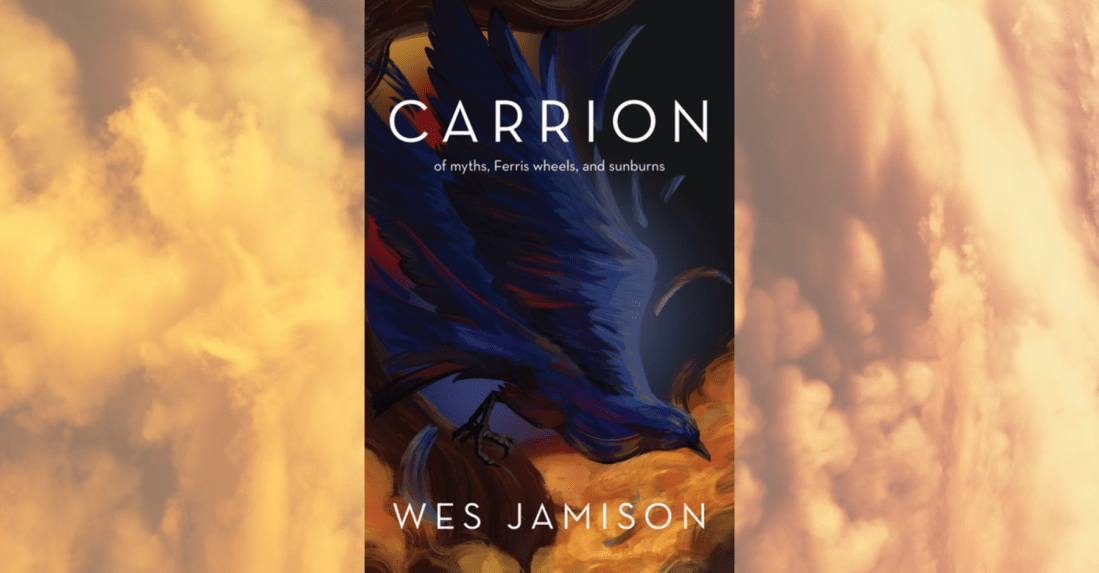
Carrion: noun. The decaying flesh of dead animals.
The word “carrion” evokes such images as the dead roadside animal who was a victim of a passing vehicle. At that moment, you witness birds such as buzzards or vultures, crows, and ravens picking at the carcass. Ravens, more than the others, bring forth images of magic, transformation, and death. And ravens can be magical creatures themselves, as in the case of Huginn and Muninn, Odin’s familiars that represent Thought and Memory. As someone who has a raven tattoo, I was immediately drawn to this collection. Wes Jamison uses ravens as the springboard for their collection, entitled Carrion. Throughout Carrion, Jamison explores how thought, memory, language, sexuality, morality, and words are expressed, or in some instances, cannot be expressed.
Jamison, who is HIV-positive, does not shy away from talking about their illness. They embrace the illness in their essay. In the opening essay, entitled “Carrion,” they write, “I have found in all ravens that which I found in that first: I am growing, I am aging, I am dying, will die.” They are honest, sometimes brutally honest, about how we all are going to die and how we face our own mortality. What makes Jamison’s essays unique is that they don’t shy away from anything. There are symbols and some metaphors but no euphemisms about topics that are hard to discuss or typically shied away from. Jamison writes, “The three letters, that acronym is another symbol. For punishment, pestilence, sin, blood, death. For promiscuity, homosexuality, risk.” Jamison uses real and frank language to describe the illness and describe how it affects their body, as well as how others view their body and their morality.
In another essay, also titled “Carrion,” Jamison writes, “They [ravens] are inquisitive, getting into everything: under banisters and inside electrical boxes on the sides of apartment buildings, huddled together on power lines and around bags of chips too large to be consumed.” Jamison also brings in the story of Noah’s ark and the way in which Noah first sent out a raven. They write, “It was a particularly intelligent bird that Noah sent first, but to send out brightest means to send our scavengers.” They argue that ravens aren’t just scavengers of the dead but are intelligent creatures. Ravens are more important than just the eaters of the dead. Ravens are more than mindless creatures.
Reading these first essays lays the groundwork for later essays that delve deeper into topics like relationships and friendships. Jamison writes in the essay “Mother,” “I don’t seek friends; I befriend those with whom I am forced into proximity…Friendship, byproduct of circumstance. Our friendships are all by proxy, in one way or another.” Do we find friendships or are they just happenstance? Do we really find our circle of friends or is it because they are simply close by? Jamison doesn’t make a judgment on that but rather states that this is what happens. They want you to think about these topics but they’re not forcing their way of thinking. Jamison brings up the question and invites you to look for your own answer. (Spoiler alert: they don’t provide the answer.)
In yet another essay titled “Carrion,” Jamison talks about Huginn and Muninn. They write, “They are carrion-feeders – they live off the dead. And Huginn and Muninn are ghosts, and ghosts were only once alive…And ash is the product of conflagration — and it all simply points toward death, toward dying, that thing we, as a culture, already know about ravens.” Very happy stuff, right? Well, Jamison highlights things we already know but don’t want to talk about. We don’t like talking about death and how we are moving towards death. Jamison broaches the subject in a way that draws you in with their beautiful language and leaves you with deep questions that may or may not have an answer.
All these essays broach subjects that may not be some “bedside” reading subjects, but it doesn’t take away from the importance of the subjects. More and more, writers stray away from touchy and disliked topics, but Jamison faces them head on with the curiosity of a raven. They investigate topics that need to be investigated. Through their frank and honest language, the reader can feel exposed, but Jamison wants the reader in that exposed state. They want us questioning things and having curiosity. Jamison admits that truth can be hard to find, writing, “If we could say it, could provide truths easily, clearly, we wouldn’t need second, third, eighteenth sentences. We would not need books.” We need this book like we need others to help us explore the ideas that go bump in the night.

CARRION
Wes Jamsion
Red Hen Press
Published June 4, 2024

 Southern Review of Books