
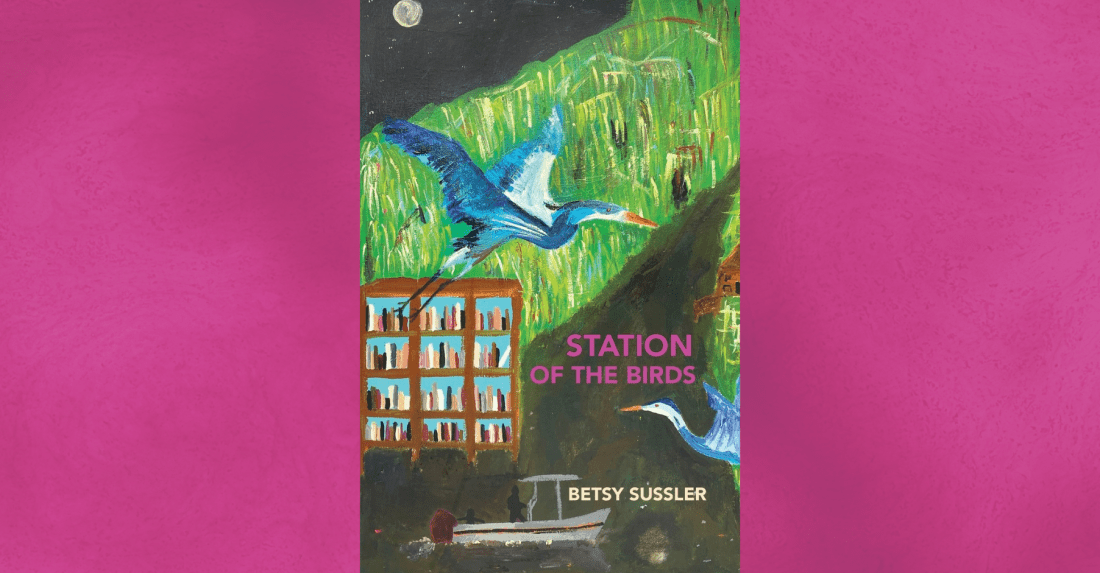
“It’s October in New Orleans, and all evenings are hallowed.” So reads an early passage in BOMB editor-in-chief Betsy Sussler’s debut novel, Station of the Birds, a tight, thrilling novel set in the bayous, swamps, and drug dens of the Louisiana backcountry. Slim though it may be, Station covers an immense amount of territory in its two hundred fifty odd pages, and by its conclusion, I felt I’d traveled high roads and low roads; cities and swamps; and, of course, some of the darker secrets of human nature. As in much of Southern gothic literature, Station of the Birds contains enough haunts and demons to go around. What makes Sussler’s all the more terrifying is that they’re of the mortal kind, made purely of flesh and blood.
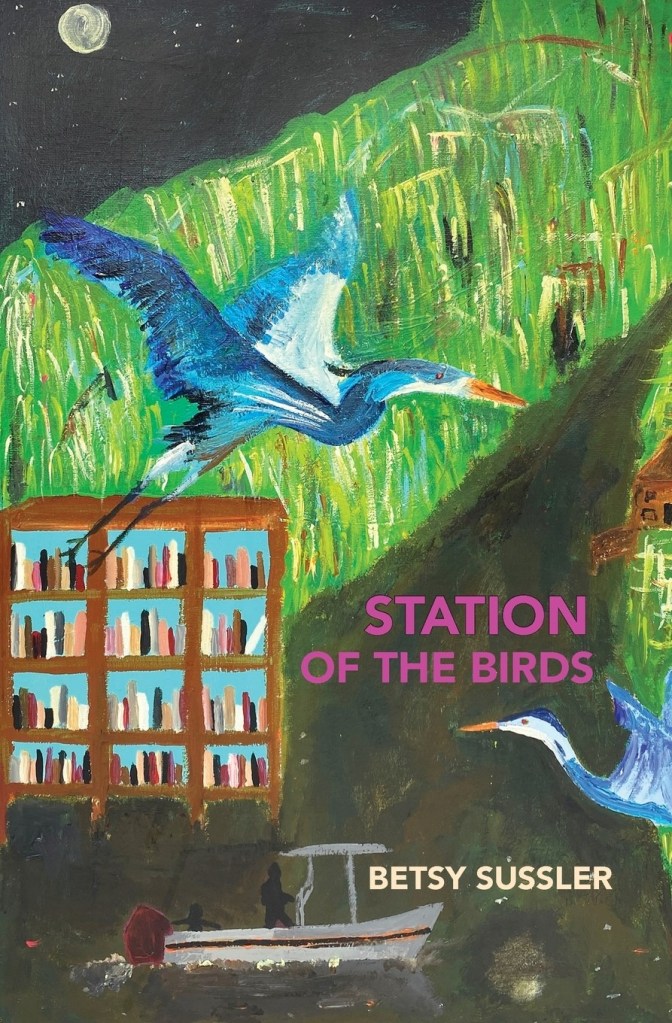
Station of the Birds takes place in 1981 in and around Louisiana’s Atchafalaya Basin. There’s a gritty, grungy element to the prose that seems well-suited to both the environment and the era. The main storyline follows Daryl Monroe, a well-educated and privileged prodigal son now a man grown hellbent on running drugs with some of the hired labor from his father’s sugar plantation, Cane Island. Daryl recruits the help of his estranged childhood friend Michael Duvet, son of an alcoholic, has-been musician, and one Monique Bouchet, who may or may not be Michael’s half-sister. The embattled relationship that quickly forms between Daryl and Monique adds a layer of relief, and humanity, to an otherwise brutal trade. Requisite gunfights and double-dealings ensue, along with just enough romance and bad religion to make each chapter sizzle. And there are the birds, of course: many of them. The great blue herons and marsh birds that populate the Atchafalayan region and Cane Island point toward the book’s title, but there are other birds, as well: jail birds and love birds and birds who’d like nothing more than to fly away and catch a break. The book’s conclusion is a gut-punch, one that left me feeling equally saddened yet uplifted, and glad to have taken the journey.
Like many Southern writers, Sussler fleshes out the novel’s background with folklore and myth. Beyond the prodigal son narrative, Station of the Birds seems to take inspiration from fraternal stories like Cain and Abel and perhaps even Romulus and Remus, since both boys, despite their ambitions of founding a backwoods drug empire, are halfway orphaned: mothers gone and fathers of little account. Daryl, especially, thinks in folktales, and tender backflashes of his reading Ovid’s Metamorphoses to his dying mother show that he is no stranger to storytelling. References to Eve and Eden and Noah, Hades and Demeter and Persephone, and countless other traditions and folktales gave me the impression that I was reading a part of something that was simultaneously ancient, even sacred, and completely new.
I also appreciated that Sussler doesn’t shy away from detailing the racial politics of the 1980s South. Daryl and Michael are white men targeting Black clientele for drug-selling. Daryl’s father’s cane plantation employs mostly Black labor. Certain establishments in the book bear “Whites Only” signs. Monique’s biracial heritage becomes a source of internal and romantic conflict. And a lynching scene toward the end of the book is a visceral reminder of our history. Racial relations in the book are handled delicately yet boldly, thereby not only contributing to the book’s verisimilitude but also reminding us, in 2026, that as far as we’ve come, we still have a long way to go.
If anything slowed me down as I read, it was perhaps the sheer number of characters who become involved with Daryl and Michael. We meet a lot of people in Station of the Birds, some more important and more savory than others, and while the sea of faces adds color and texture to the world, I found it occasionally challenging to keep track of everyone implicated in the 3 drug-running scheme, and of who was betraying whom. Even so, this busy blurring or, to use the book’s own term, shimmying, of major and minor players seems, if anything, a more accurate representation of the life of a drug dealer, where human beings are little more than tools to be utilized briefly and then abandoned to the swamps. Even friends aren’t really friends in the drug business, the book suggests, and cold a truth as it may be, that realism is satisfying.
There’s much to recommend about Sussler’s writing: lush, vivid prose; haunting landscapes; a palimpsest of tales and traditions that write into, rather than overtop, each other, creating new landscapes and myths. Station of the Birds reminded me of the writing of many other contemporary women writers whose work, in the tradition of Eudora Welty, dabbles in mysticism, folklore, and Southern grit: Kimberly Brock, Julia Elliott, Lauren Groff. What these writers bring to the isolation of Cumberland Island, or the Southern hinterlands, or Florida swamps, Sussler brings to life in the Atchafalayan wilderness. Yet, perhaps unlike the others, Station of the Birds presents a distinctly man’s world: a no-man’s land in which violence begets violence and the sins of the fathers are inherited, and paid for, by the sons.
The result is a poignant sense of mourning and longing perhaps best explained by the book itself: “Birds fly to survive. They flock in a swirling mass, a fortress against predators… Men fly to escape, to leave for someplace else, to find something other than what they have. They’re searching for God.” This search — for something bigger, or greater, or impossible — follows Daryl and Michael throughout the book. Some birds, the book reminds us, do, in fact, fly south: cyclically, and willingly. Others, the ones who are born there, have to make the best of it.
FICTION
Station of the Birds
By Betsy Sussler
Spuyten Duyvil
Published January 18, 2026

 Southern Review of Books
Love Southern gothics, I’ll have to check this one out!
LikeLike