
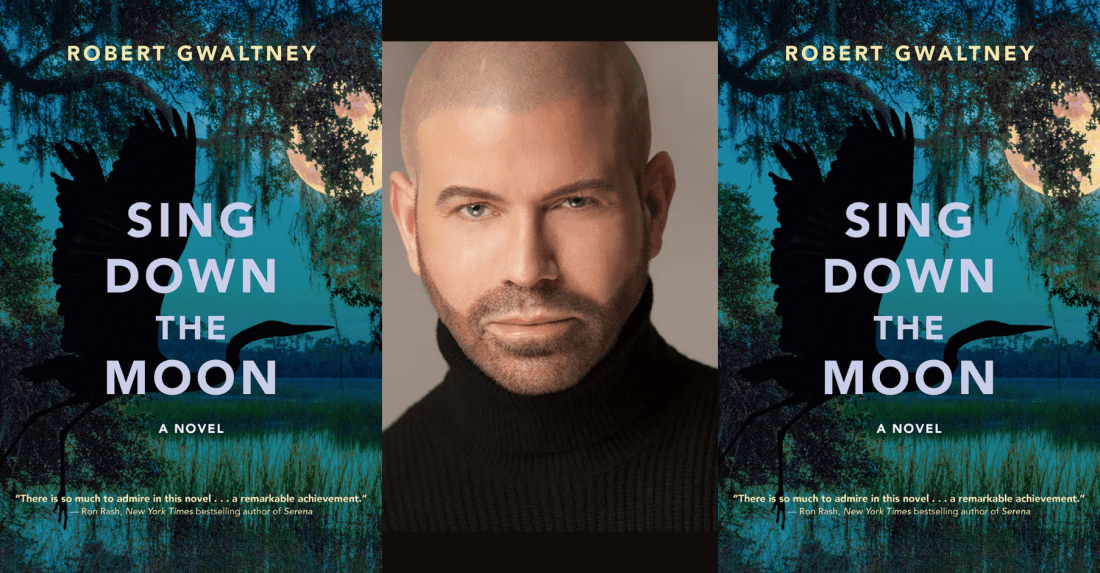
Years ago, I met Robert Gwaltney outside a local Atlanta bookstore and, within minutes, I knew I’d met a kindred spirit. He was working on finishing his first novel, The Cicada Tree, for which he’d win the Georgia Author of the Year Award for Best First Novel in 2023. We fantasized about escaping somewhere to write distraction-free, and he shared that he had recently rented a house in a secluded area of North Georgia to do that very thing.
The backdrop of Gwaltney’s new novel, Sing Down the Moon, is Georgia’s very real barrier islands, but it is also a fantastical landscape seething with haints and riddled with family secrets and betrayals. From the first page the reader is transported to the verdant salt marshes of the low country, where time is muddled. Is this a corrupted Garden of Eden, a low country Hades, a post-Rapture Wonderland? Maybe all three.
His characters are an amalgamation of the grotesque in Southern Gothic and the absurd in magical realism. The novel is heavy on dialogue interwoven with hymns, lyrics, and poetry, and accompanied by repetitive auditory imagery. Refrains are echoed to create a grand operatic narrative about 16-year-old Leontyne Skye.
A beacon for both new and established Southern writers, Gwaltney is an acting board member of the Broadleaf Writers Association. With author Jeffrey Dale Lofton, he interviews Southern writers for “Inside Voices,” a podcast by WELL READ Magazine. He participates in literary events throughout the Southeast and is part of the M’ville Artist Salon. If something is happening in the Southern writing scene, Gwaltney is there, and always welcoming. The saying, “There’s no such thing as a stranger in the South,” rings true with him.
Robert’s work has appeared in Southbound Magazine, Southern Literary Review, The Blue Mountain Review, and The Dead Mule School of Southern Literature. In 2022 he was a recipient of the Pat Conroy Writer’s Residency, and he is the new recipient of the Somerset Award for Literary and Contemporary Fiction for Sing Down the Moon, about which we interview him here.
You experiment with genre-blending. But I’ve seen a movement in defining a Southern magical realism separate from Latin American magical realism. And Sing Down the Moon is the result of that evolution — a cross-pollination of the Southern Gothic with a new Southern magical realism. Do you agree? Are there other genres that you tapped into when writing your novel?
Yes, Sing Down the Moon is very much a blending of genres bleeding into this idea of Southern magical realism. The story’s fantastical elements — haints, Redemption, the disintegration of the Skye women — are rooted in the folklore, history, and landscape of the Georgia barrier islands, so the magic emerges organically from the Southern setting. At the same time, the novel draws on Southern Gothic, with its focus on decay, family curses, isolation, and moral ambiguity.
Beyond that, one might argue that there are tendrils of dark fantasy, psychological mystery, coming-of-age, and even romance. The result is a hybrid story where the supernatural, the personal, and the cultural all collide. But at its core is Southern identity — its place, its myths, its sense of legacy.
Your main character, Leontyne Skye, bears the name of one of the first famous Black opera singers, Leontyne Price. I stated earlier that the novel is operatic. It feels as though the narrator is acting like a conductor of an orchestra. Will you discuss that operatic effect and how music and poetry factor into the story?
You are spot on. Leontyne Skye’s name is an intentional nod to Leontyne Price, one of the first internationally celebrated African American opera singers. And music is a great source of inspiration for me in my writing. I absolutely embrace the idea of scenes rising and falling like movements in an opera — moments of high tension, lyrical introspection, and climactic revelation mirroring musical crescendos and decrescendos.
Music and poetry are woven throughout the story to heighten that operatic effect. The “wind chime song” of Damascus, the fig tree, and the lyrical cadence of Leontyne’s reflections all function like musical motifs. The prose sometimes mimics the structure of poetry, with attention to rhythm, imagery, and echo, so that I hope the reader experiences the story almost like listening to an aria, with emotional intensity and nuance rising through each passage.
The novel is dream-like and your characters are either mad or possibly on the brink of madness. I found this to be reminiscent of Lewis Carroll’s Alice in Wonderland. The Singing Prophetess reminded me of the Queen of Hearts. Darkly, Leontyne’s pet rabbit, is not quite the White Rabbit but a rabbit, nonetheless. Your magical potion, Redemption, transports your characters. Time doesn’t function normally and of course there’s a pocket watch that’s passed around. Who were some of your literary influences?
You’re absolutely right — I feel the novel has a dreamlike, sometimes disorienting quality, and that was intentional. Some of the characters teeter on the edge of madness, time is fluid, and objects like the pocket watch and Leontyne’s pet rabbit serve as anchors and symbols, much like you might find in stories the likes of Alice in Wonderland.
As for literary influences, they are wide-ranging. Southern Gothic writers like Flannery O’Connor inspired the sense of place, decay, and moral complexity. Magical realism from writers like Toni Morrison and Gabriel García Márquez certainly inspire the way I integrate the supernatural into daily life.
The book is riddled with allusions to Greek mythology and Biblical symbolism. There are references to places such as the Elysium (a mythic Greek paradise), Biblical characters such as Salome (who requested John the Baptist’s head on a platter), and events like Tribulation Day (Judgment Day). All of this adds depth. I use “riddle” deliberately here. It’s almost like reading a story within a story. What were some of the stories from Greek mythology and/or the Bible that inspired your narrative and how?
Yes, the novel is certainly inspired by and layered with Greek mythology and Biblical symbolism, and I like that you noticed the “riddle” quality — it’s almost like the story is a story within a story. As for Greek myths, they inspire me in terms of archetypes, fate, and consequences. For example, the Elysium references evoke a paradise that’s both desirable and unattainable, echoing Leontyne’s longing for escape and the tension between destiny and free will. The violin named Salome, and events such as Tribulation Day, draw directly from Biblical narratives to explore judgment, sacrifice, and the moral complexity of power.
I am particularly interested in how myths and Biblical stories function as moral and psychological touchstones: they provide a framework for understanding suffering, redemption, and transformation. Leontyne’s journey mirrors the hero’s journey in mythology — she confronts forces larger than herself, deciphers riddles of the past, and ultimately makes choices that affect not just her life but the balance between the living and the dead.
You’ve expressed trepidation over how this novel would be received. I saw Leontyne’s amputated hand as a metaphor for the loss of her muse. Did some of that worry play into a fear of your voice not being understood?
At the heart of things, like most creatives, I suffer moments of insecurity. Sing Down the Moon is my second novel, so there is all the worry that accompanies a writer’s sophomore effort. The book is also a bit different stylistically from my debut novel, The Cicada Tree, so I hope that readers are open to this new experience. I don’t want to disappoint my readers, and I certainly hope to find new readers along the way. In the sweet by-and-by, I am immensely proud of Sing Down the Moon.
Ann Hite, who wrote the introduction to your novel, is an authority on haints. But you’ve added your spin to these mysterious spirits. How would you describe your haints?
The generous and talented Ann Hite is most certainly an authority on haints, and I am pleased she embraces my interpretation, which assigns these spirits a corporeal presence on the page and in the world. Possessing the look of puffer fish, my haints swim the air glowing a dazzling shade of purplish-red. And they are also quite amorous, desperate to wheedle their way into the sweet, warm pulpy middle of the Sarah Figs that grow on the mythological tree called Damascus. And how they ache for earthly pleasures, calling out to the marsh and Leontyne Skye, “More, more, more.”
We wish you the very best with Sing Down the Moon and all your future endeavors.
Thank you for having me.
FICTION
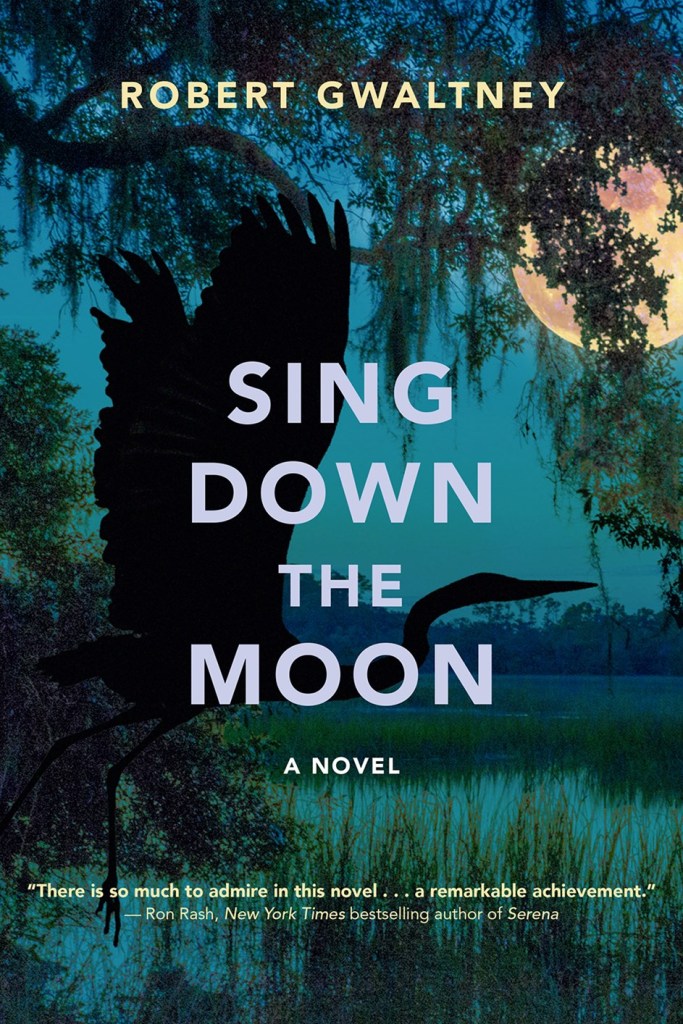
Sing Down the Moon
By Robert Gwaltney
Mercer University Press
Published March 3, 2026


