
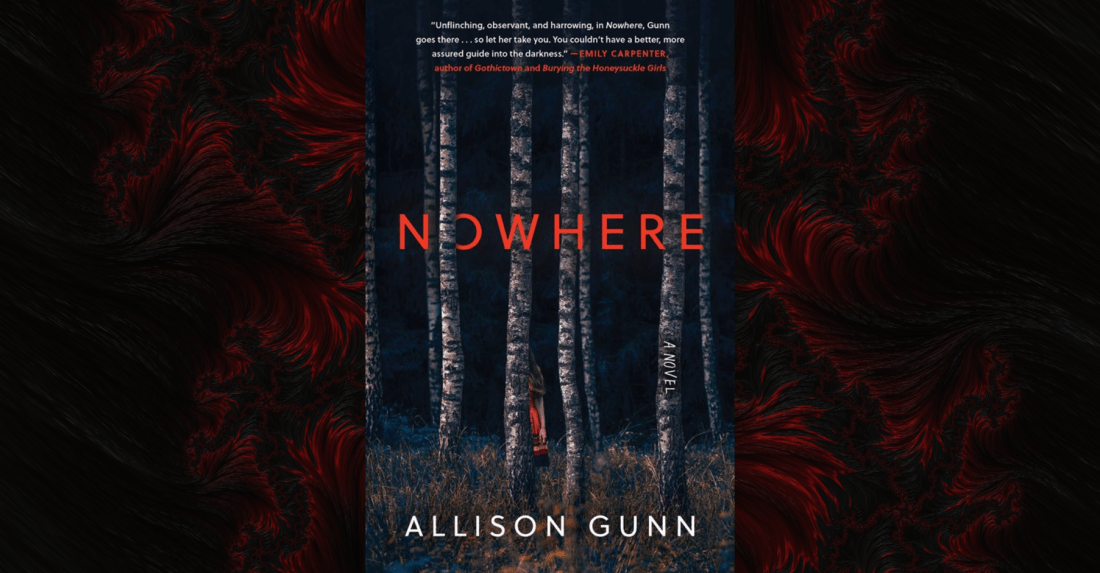
On the surface, Allison Gunn’s Nowhere is the supernatural, twisted tale of Rachel and Finn Kennan, a couple whose marriage fractured long ago after the death of their son, though they continue living together in less-than-ideal circumstances. However, Nowhere does not only follow Rachel and Finn: it is also the tale of Dahlmouth, a small Virginia town where racism, evangelicalism, and a deeply sinister questioning of anyone and anything from the outside permeates the town’s social threads. Rachel and Finn, of course, as outsiders who moved to Dahlmouth in order for Rachel to pursue a law enforcement career. Two central themes exist in the townspeople’s gossip: Finn, whose scathing (albeit award-winning) journalistic critique of Appalachia automatically placed a target on his back, is seen as pretentious due to his DC roots. Similarly, Rachel — who also serves as Dahlmouth’s Chief of Police — had past queer relationship unearthed by a few local kids via social media and who, to the outrage of many of the townspeople, continues to reside in town and serve in her law enforcement position. When some locals discover a murdered hiker in the local forest, many of the townspeople blame Rachel and her past. However, what they fail to realize is that something much more sinister than a few outsiders moving into town is about to unleash itself on Dahlmouth.
For some, Nowhere’s grisly thriller-horror elements will eclipse the novel’s philosophical ones. Thus, readers should prepare themselves, because Nowhere offers The Ring-like supernatural gore. A strange, demonic force lures Dahlmouth’s children into the forest. Teenage girls are eerily possessed by spirits that transform them into well-dressed, well-spoken beings their families do not recognize. Dahlmouth’s adult residents murder one another as mysterious voices fill their heads, and many of them tear out their own eyes. With all its gory depictions, Nowhere mirrors thrillers like American Psycho and Letters from the Purple Satin Killer. However, its philosophical takes on small-town dynamics combine with all the best components of horror writing to create a genre-bending page turner.
Nowhere, too, is an exquisitely clinical exploration of grief. Finn carries an immense amount of grief about his son’s tragic death. He also — in a manner that juxtaposes most of the macho, backwoods male figures in Nowhere — grieves his marriage’s collapse. Gunn portrays Rachel as a stalwart, all-business chief whose dedication to her career overshadows her openness, honesty, and vulnerability with her family. Despite the tough persona Rachel displays, she is weighed down by her own grief from her son’s death. Also, Rachel is bound by another type of grief—that which stems from being unable to live authentically. Rachel’s thoroughly tumultuous marriage to Finn gave her three beautiful children — two living daughters and their late son — but it has also left her living under the guise of being a heterosexual woman and devoted wife. In Rachel’s reflections about her carefree, pre-Finn past and her relationships (domestic and romantic) with women, her grief in hiding an essential part of herself is clear, recognizable, and heart-wrenching.
The town of Dahlmouth, even before the strange haunting , was a scary place, and Gunn masterfully weaves fiction with reality. Outsiders — and especially those from the cities — are viewed with deep suspicion. The teachings of the local church grip believers tightly, holding them in guilt and subjugation. In this, Gunn manages to modernize age-old stereotypes about the hills and the hollows held sacred in the Appalachian mountains. Dahlmouth’s geographic isolation parallels its socioeconomic and even spiritual isolation: no one leaves, and very few newcomers ever arrive; the town is culturally and economically stagnant, and those who dare to leave rarely ever return. Dahlmouth, nonetheless, serves as an eerie symbol of a familiar Appalachia. Thousands of small towns throughout states like West Virginia — the state Gunn currently calls home — experience severe population decline, economic collapse, and environmental and industrial risks. Similarly to many real small towns, Dahlmouth’s lack of diversity — religious, racial, and cultural — creates fear in some residents about the unknown and those who are different. Nowhere, despite its thriller-horror elements, may have more real-life lessons to teach its audience than one could have initially imagined.
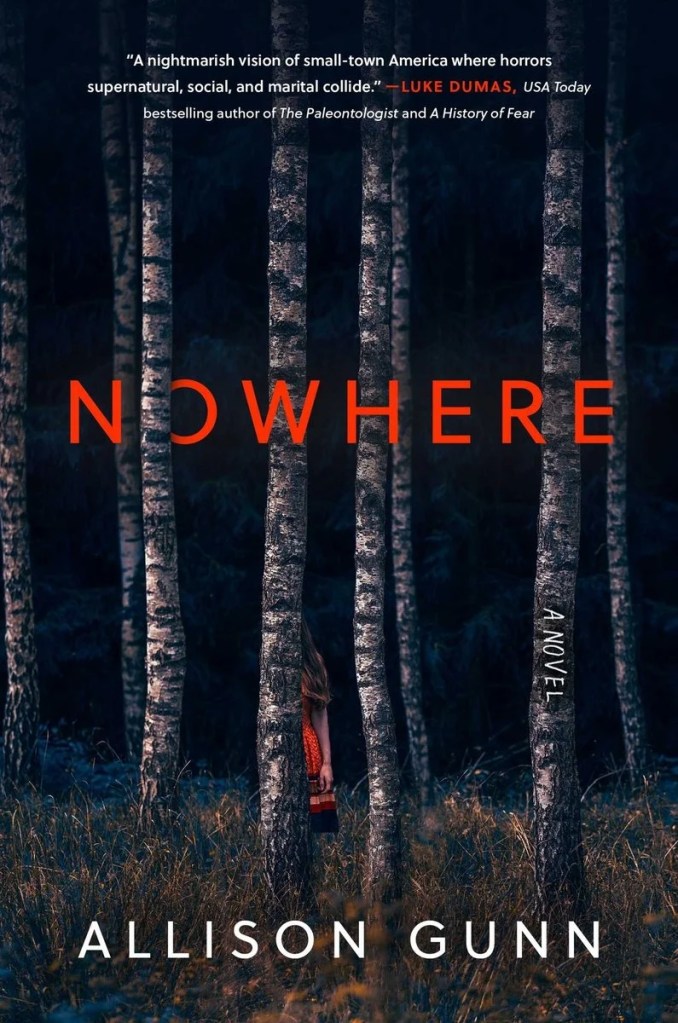
FICTION
Nowhere
By Allison Gunn
Atria Books
Published March 25, 2025

 Southern Review of Books