
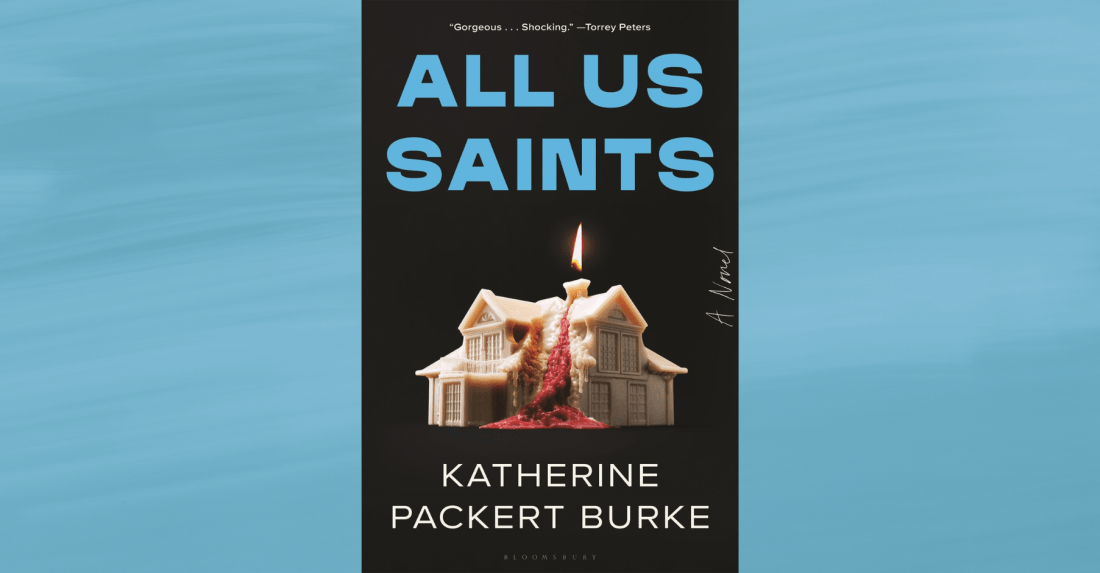
In All Us Saints, Katherine Packert Burke explores the dark shadow of the experience of transgender people in the context of a too-tightly-knit family. With an inheritance of questionable origins, the St. Cloud family home is a setting haunted by big and small violences. Burke calls into question what we cling to as individuals within a family: identity, wealth, purpose, and power.
It begins with a Dramatis Personae, introducing the characters: playwright (Calla), photographer (Edna), cinephile (James), a full list of siblings and significant others. The setting: May 31, 2011, and 2012 in a small Virginia city, home of the St. Clouds. This date brings them home each year to the scene of the crime, where Edna, the eldest daughter, still lives with her husband (Roger) and daughter (Wren). This is also where, in 1992, Roland (eldest brother to James and Calla, twin to Edna) killed three of Edna’s friends and nearly killed Edna too. Roland is listed as “The Monster” in the Dramatis Personae, striking a chord of tension on page one.
Edna forces the family home each year, like some perverse Christmas gathering, to relive her trauma, their family trauma, and reenact the “ritual” with a controlled narrative. They check each room for monsters, lock the doors, light candles, blow them out, and tell the story they wrote about the night. The prologue, House Lights Up, moves seamlessly from character to character approaching the evening of May 31, 2011. There are movies, sequels, and spin-offs about this very night, sensationalizing their family’s deepest hurt. There is the book that Roger wrote, which made them all famous. That is the narrative they stick to for the ritual, though the truth is muddier. The narrative makes Edna feel safe.
Act One begins 19 years after the killings, once everyone has arrived at the St. Cloud home. We are grounded in the characters quickly, as Edna lists her surroundings to prevent a panic attack:
“Deep breaths. Five things she can see: the bookshelves, Roger’s record collection, assorted paperweights, the photo of Wren on the mantel, these floorboards were never touched by blood. Four things she can feel: the poker’s weight, the cool wall against her neck. A splinter in the arch of her foot. The scar’s white furrow an inch below her clavicle; in cold weather, it sometimes aches, and her arm stiffens, but now it is painless — only skin. She hears the footsteps pause in the darkening house around her. The frogs in back singing through the trees. It has been nineteen years. Nineteen years.”
The reader is told the story of that fateful evening in 1992, what Edna recalls mingled with the movie adaptation. What was Roland thinking when he put Edna’s old prom dress on to kill her friends? Was there ever a prom dress, or was that embellished too? The scar is real, her friends are dead, but Edna has told the story so many times that she can’t question its truth. In none of the narrations do Roland’s actions make sense. Only when The Monster Speaks, the title of the Intermission, where we get Roland’s perspective, does the story begin to add up. Burke forefronts the power of a narrative, who gets to be the storyteller, and who has agency to speak. When people are stripped of their dignity, not believed, and not heard, they are capable of some pretty monstrous things. Does that make them a monster?
I was moved by the intermission. Roland became an anti-hero to me then, as I felt a surge of justice reading Roland’s murder of Beatrice. Too far? Sure, but in Roland’s mind, I could see how they deserved it. I could feel the dysphoria, the claustrophobia of the body, the limits of the family home, and the limits of the mind to see a future beyond it. The one thing Roland was good at was making dolls. Dolls being the queer community’s term for transgender women or transfemme folks. The question of whether Roland was a transgender woman is barely a question by the end of the intermission. Roland became a monster in everyone’s stories, but in a better town or better family, with better people and support, Roland could have been a doll.
I don’t need to tell you how important stories about transgender people are right now, and I don’t think Burke is trying to say look, this is what happens when transgender kids don’t get HRT. Transgender kids aren’t a threat. Rather, I think Burke is asking the reader to consider the narratives that are being told about transgender people. There is a lot of hurt perpetuated to “make people feel safe” in bathrooms and sports. There is a lot of power in these narratives, which alter and diminish transgender lives. The stories we should listen to about transgender people are the stories they tell us about themselves. Our country does not have to be a haunted house where pain is held, when there are woods behind the house. There are rivers, and cities, and a lot of life beyond where these stories are held captive.
The question of whether to burn it all down is central. Is it time to burn down the house? Are you capable of it? The action may mean less than the question. Calla (the playwright, Edna and Roland’s little sister) burns down the house again and again in her videogame The Neighborhood, a sinister virtual reality that offers little comfort to the folks who escape there. Calla dubs her digital replica of the St. Cloud family home “the Spitehouse” and obsesses over the vault she did not build, which appeared in the basement of her digital home. There is a secret in the soul of the house.
Each of the siblings addresses their own gender and sexuality more openly than Roland was ever able to do. They are still repressed by their proximity, the feeling that each would judge the other. There is also the fear that their own queerness may link them to Roland, which is too troubling to consider. They want distance from what they fear, yet they are drawn together.
Act Two is “The Next Year” or May 31, 2012. All of what you expect is subverted when a heretofore off-stage character, whom you may or may not recall from the Dramatis Personae, becomes a catalyst: “Sarah Fletcher, 20. A local.” Sarah is Calla’s mysterious girlfriend, who knows the house intimately. Her character doesn’t feel fully fleshed out, even as her presence dramatically alters the story’s end, but I suppose that is the circular nature of violence. Her perspective is untold, though there will be talk about her. It’s the way these things go. Burke doesn’t prescribe us anything for this brutal cycle, except maybe that it is okay to leave home.
FICTION
All Us Saints
By Katherine Packert Burke
Bloomsbury Publishing
Published May 19, 2026


