
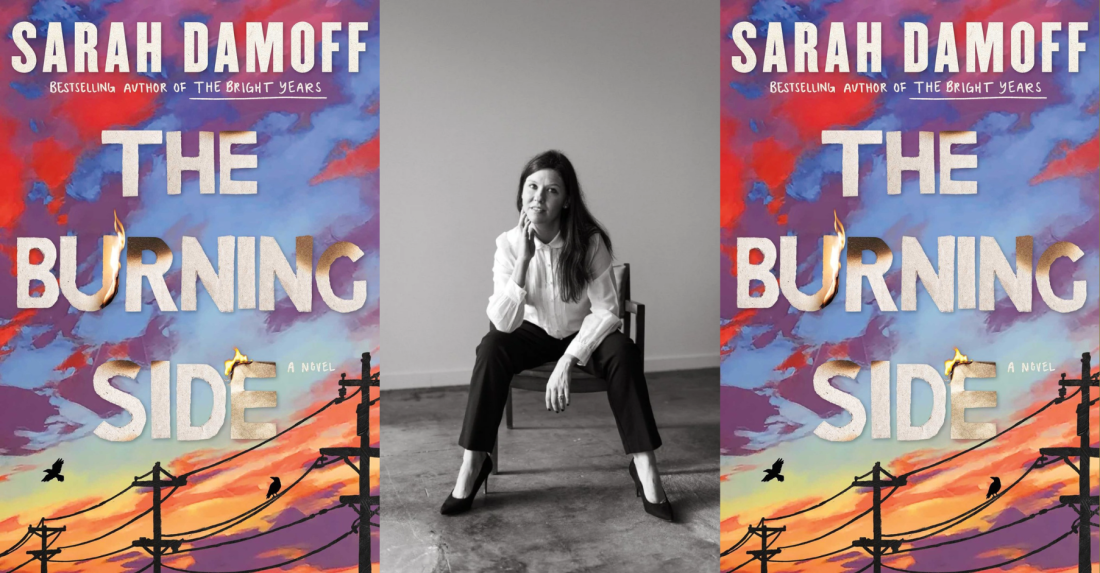
Last spring, I had the honor of reading The Bright Years by novelist Sarah Damoff, so I knew as soon as the ARC became available for her second novel, The Burning Side, I had to get my hands on it.
The Burning Side follows April and Leo Torres, beginning on the night that their house burns down. This is the launching point for a story that unfolds both organically and tangibly. April and Leo, along with their two small children, move in with April’s parents, Deb and Billy, who have always treated Leo as one of their own. In fact, they are the closest thing Leo has experienced to having loving parents, which makes it all the more devastating that Leo is in the process of filing for divorce from their daughter. Between the fire, the looming divorce, and a household full of adults and children, there’s plenty going on. Yet, on top of everything, April and her two siblings, Josie and Cameron, must also grapple with the fact that Billy is in the beginning stages of Alzheimer’s.
Set amongst the city streets of Dallas and rural pastures of Texas, The Burning Side is a family saga told from the three different perspectives of April, Leo, and Deb. Through the heartbreak, devastation, and long history of lived life, each character must continuously come to terms with each other’s humanness — their unwavering ability to fail and forgive, love and lose, remember and regret.
Damoff has an intrinsic ability to draw characters on a page with her beautiful words. Luckily, Sarah Damoff is as generous with her time as she is talented with her writing, and I had the opportunity to hop on a screen to chat with her about both The Burning Side and The Bright Years.
Both of your books are so real; the scenes and characters are visceral. As a reader, you can picture yourself in each moment. In the author’s note, you mentioned that the inspiration for this book came primarily from spending time with your husband’s grandparents when you lived with them as newlyweds. Did you grab any specific moments from your time with them and put them in the book? Are there any characters that are based on someone specifically?
There’s an overlap because you take this one little idea, a feeling or a phrase, and then go give it over to your imagination. So all of it comes from something within me and my lived experience.
Yes, the original idea for The Burning Side was very much because I had this unique experience (especially unique in modern Western culture) of multi-generational living, specifically at the very start of my marriage and the very end of [my husband’s grandparents’] marriage. At the time I was so young, but I was aware that it’s almost like two different categories of love and marriage.
And so it was just this idea of how can I explore these two marriages and the impact of multiple generations on each other? How do children impact their parents and parents impact their children and grandparents as well? Specifically, in The Burning Side, how marriage is bigger than just two people. It’s their families as well.
My husband’s grandmother, whom we lived with, had Alzheimer’s. My grandmother did around the same time. Seeing some of that “time travel” element where they’re confused about where they are in time, in their own brain, is like all of their life is in front of them at once and they can’t sort it out. So there’s not a particular moment, but it was trying to put that whole experience on the page and let the characters come to life in their own way.
As a reader, I love books for the experience. But as a writer and editor, I think the most fascinating part is the process. For instance, how many drafts do you go through? Are you a plotter? Are you a pantser? Can you tell me about your experience?
Yeah, I’m a pantser for sure. I love hearing about people who write really intellectual mysteries, and they have to plot it all out. To me, that kind of brain is amazing. But I always describe my writing experience as like reading, but amplified, because I am sitting down thinking what’s going to happen next. And there’s a propulsion to that, like I’ve got to discover it. So that’s really fun. I draft fast because it’s kind of a compulsion, then do several revisions.
At that point, I’ve got about five people who are thoughtful early readers who can give me diverse feedback. And then once I have the story out, the most important thing for me is time away from it. It’s hard to be objective about your own work, but it’s easier if there’s time away to see what’s not connecting and what holds up.
On that note, did you always foresee how the stories would unfold?
I did to a degree. With both books, I didn’t really have a plan, but I’d have a general sense and then just see how it unfolded, which is a really fun way to write because the characters in the story can be surprising. So while I always intended on some things, I had to figure out how certain events would happen to navigate that.
I always knew Billy was going to have Alzheimer’s. I knew I wanted it to be a lot about memory — we’re seeing how 2011 connects to 2022 and we’re back and forth the whole time to specifically get this feeling that it’s all connected.
As relationships progress through years and years, you have different memories of how you got to where you are. So I knew we were going to have this pull back at the end, a 30,000 foot view, to kind of see everyone in their different places and how they got there. I didn’t write for a message, but the feeling at the end is, this was and is hard, and I would do it again.
Who are your favorite authors? Do you like to read some books for your personal enjoyment then read other books for professional development or research?
That’s a great question. I’ve never put such a distinction like that between personal and professional. Mostly, I feel like if I’m reading for professional purposes, it’s usually like an advanced copy to give a quote or something like that. But in terms of learning and taking for myself, there’s really such an overlap between what I love to read and how I hope to write.
My favorite book of all time is The Poisonwood Bible by Barbara Kingsolver. I think that her prose is just incomparable. I mean, she’s phenomenal. I’ve also always loved poetry. So Mary Oliver, Wendell Berry, Ada Limón. It’s interesting because I love Joan Didion and Dani Shapiro, and they’ve both written novels and memoirs. And then one of my other favorite authors of all time is Maggie O’Farrell. And I actually get to interview her this summer, which I’m so excited for. Like, more excited about that than any of my own events!
Is there anything that I didn’t ask today that you want to want readers to know?
I’m always grateful for readers. My editor told me just a couple months after The Bright Years came out that Simon & Schuster had never seen that kind of word of mouth with a debut. So I’m always looking to tell people thank you for putting it in the hands of other people. It’s amazing to see anything that has happened in terms of awards or recognition. I’m just like, the readers made this happen. There wasn’t a celebrity or book club person that did this. The readers did this.
I’m just so grateful for the whole journey and I hope to keep writing forever. But thank you for that. That’s amazing. It’s interesting, too, how stories always find their way to people who need them when they need them.
Sarah Damoff’s The Burning Side is now available for purchase. Check out her website or Instagram to find info on her upcoming book tour!
FICTION
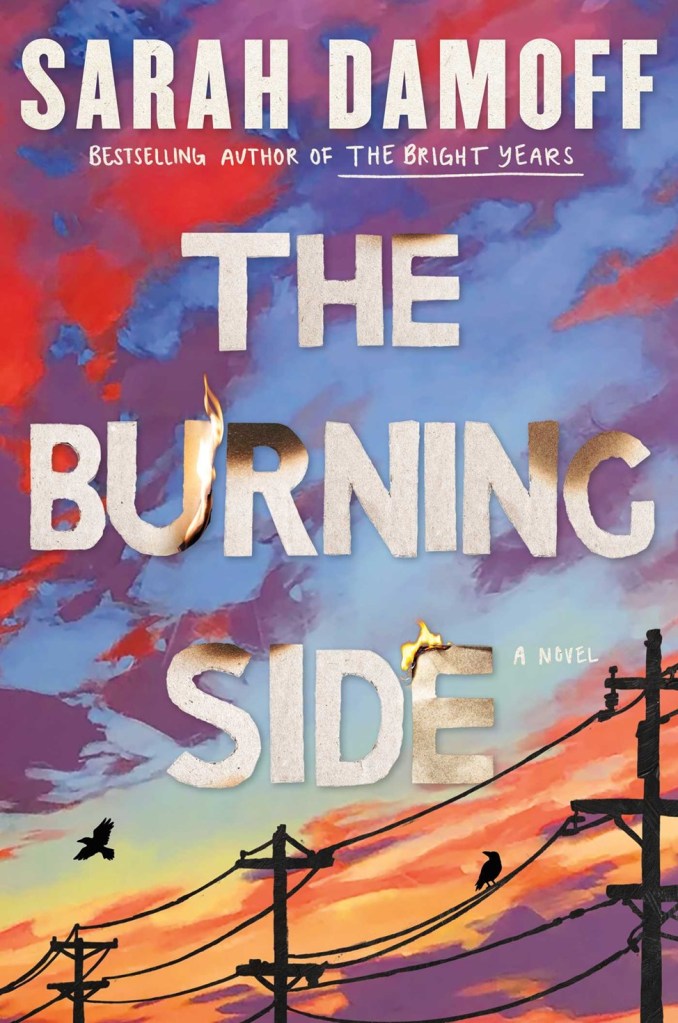
The Burning Side
By Sarah Damoff
Simon & Schuster
Published May 19, 2026


