
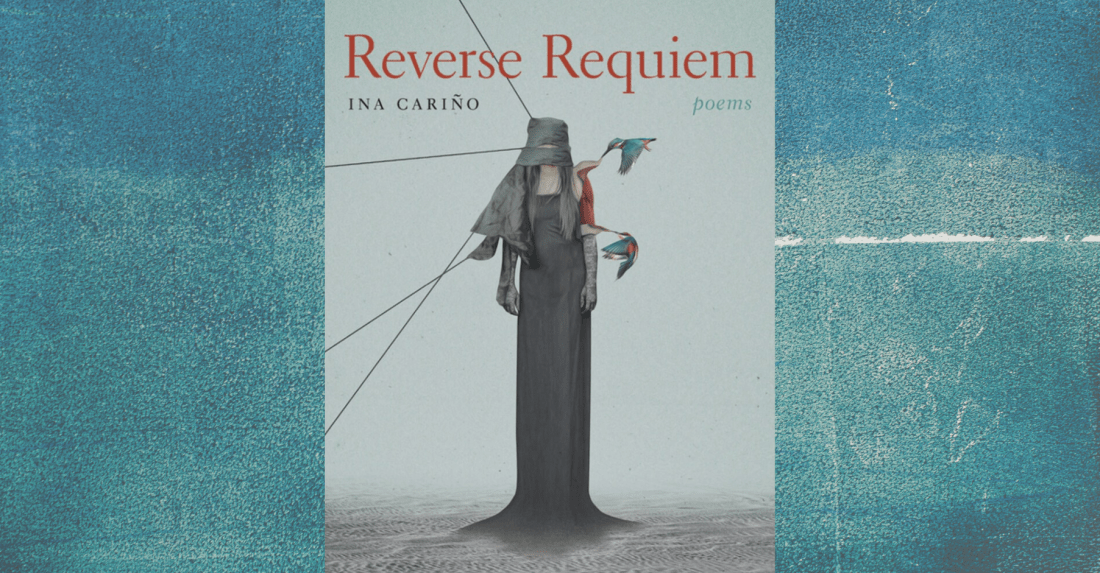
What is it to reverse a requiem? The traditional (read: Catholic) concept of “requiem,” a musical composition or mass for the dead, offers few gestures toward its opposite, and so we turn to poetry. I imagine a vinyl played backward, creating surreal sounds or unveiling coded messages. Or is it death itself that is reversed? The requiem unraveling, end to beginning, bringing the mourners into a griefless world they thought had dissipated? Maybe what’s reversed is the subject: the composition is a song intended to be heard by the living sung by the dead. Reverse Requiem, the sophomore collection of poetry from Ina Cariño (they/she), reverberates with all of these interpretations and more: music about loss, grasping toward plenitude and desire and rejecting scarcity and self-suppression, and reinforcing the threads of connection between their long- and newly-dead ancestors and the still-breathing descendants.
These poems of Reverse Requiem juice with life. They rot and seep. They act like (and often include as images) hot liquids — ginger broth slurped on New Year’s or alphabet soup smeared on the face, blood splashing, hot gravy poured over a pig. Cariño savors and delights in rich language and full emotions. In “Self-Portrait as Foreign Body with Storm in My Lungs,” a poem of anaphora about their first name, the “suffix” Ina, they write at the beginning of the poem “as in, I grew smaller & smaller under empire’s eye,” and by the end, “as in, at nights, I nest into a thousand feather pillows, whisper my name to myself… / as in, I cover myself with the dirt of my ancestors—play in the ochre mud as they nourish me with their music.” In many of these poems, family (often associated with dirt, mud, soil) and the actualized self provide solace from the wider world of homophobia, racial othering, and epigenetic colonial violence.
The idea of nourishment, particularly through food — eating, the shame of eating, the desire to be full, the decadence and deeply held memory of certain foods — reverberates throughout the collection. So does the natural world: plants (the Japanese maple ripped from her grandmother’s land in “Native Title,” the opening poem of the collection), stars, and earth, which, alongside the familial symbolism mentioned above, Cariño returns to again and again as a literal and spiritual connection to her heritage and childhood in the Philippines.
Cariño’s poems are staunchly anticolonial, cognizant and indignant in the ongoing wake of empire. One standout poem: “War Supply,” pairs the colonial experiences through persona of two violated Filipina women — one woman abandoned by her child’s father, another forced into prostitution. War and revolution pepper these poems in photographs and snatched memory. In the poem “Tae,” the speaker visits “mama” who has been harassed and targeted by a neighbor, a white ex-sergeant, for a decade. There is a pull toward community-driven justice and righteous anger in these poems: “my knowledge comes from the people before me. / my courage comes from the people next to me / & I want to unravel words intended for slaughter.”
The book itself sports a satisfyingly wide trim size, which seamlessly accommodates poems with lines more than six inches long. Cariño seems interested in expansiveness as a poetic practice both formal and thematic: one of the only two “small” poems, “Event Horizon,” takes as its subject the breadth of human hubris and migration (inclusive of lighter and darker manifestations in immigration and settler-colonialism). “we are the brazen ones who cordon off / the skies & parcel out islands.” Almost every other poems use length, width, imagistic leaps that allow the works to stretch: embodying, literally, the taking up of space. Most poems in Reverse Requiem feature Cariño’s signature grammar and style (punctuated sentences with lowercase beginnings; ampersands aplenty).
For a collection with music in the title, I searched for music more often than I found it in the lyricism of these poems. Cariño more often oscillates between narrative and imagistic abstraction than a true lyrical mode — and the absence of sonic resonance is made up for by the sheer pleasure in the number of distinct poetic forms found in this collection. Abescedarians (including one incredibly ambitious ghazal-abescedarian), a pantoum, a sonnet crown, prose poems, poems that can be read across the line or down each column.
Often, reading Reverse Requiem was to be propelled by raw emotion, to allow myself to be haunted by narrative rather than facing it head on. The final line in “A Wound Is a Form of Surrender” — “I sing the oldest anthem, drink deep from the hottest bowl” — demonstrates another signature of Cariño’s: metaphors rich with superlatives. But poetry that arcs toward requiem should sing loudly, mourn boldly, and play into excess. After all, restraint and quietude are tools of the colonial tradition — these poems reject restraint at every turn. Maybe another way to sing a requiem in reverse is to take it out of the somber sanctuary and sing directly to the dead, wet with tears, hands in the turned over earth.
POETRY
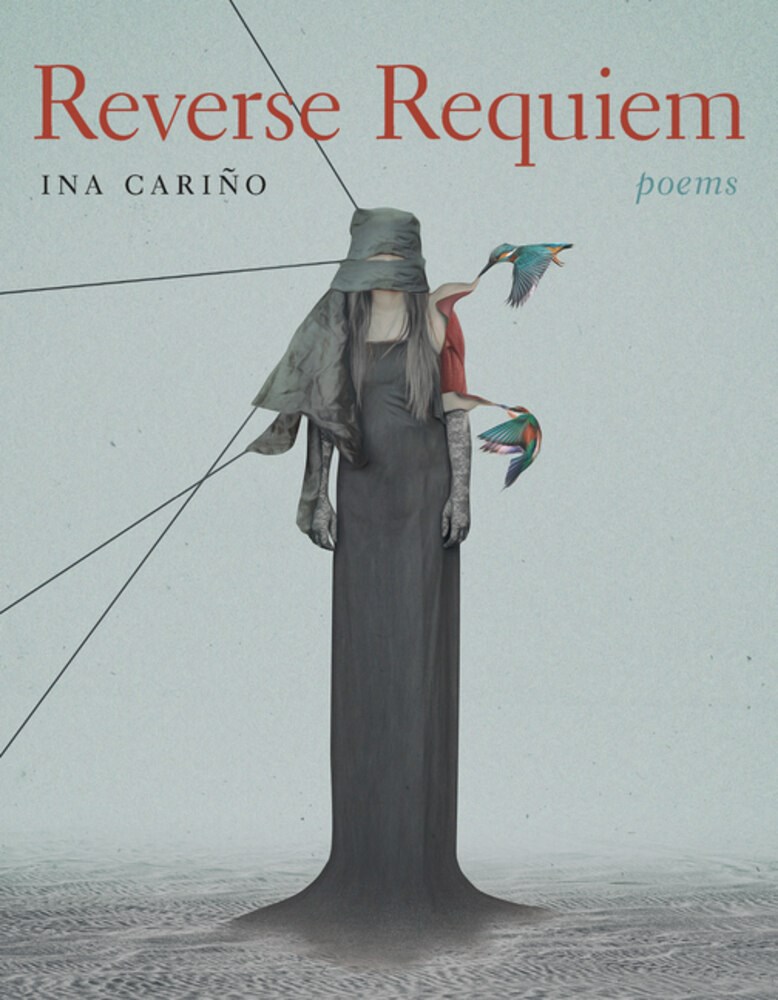
Reverse Requiem
By Ina Cariño
Alice James Books
Published April 14, 2026


