
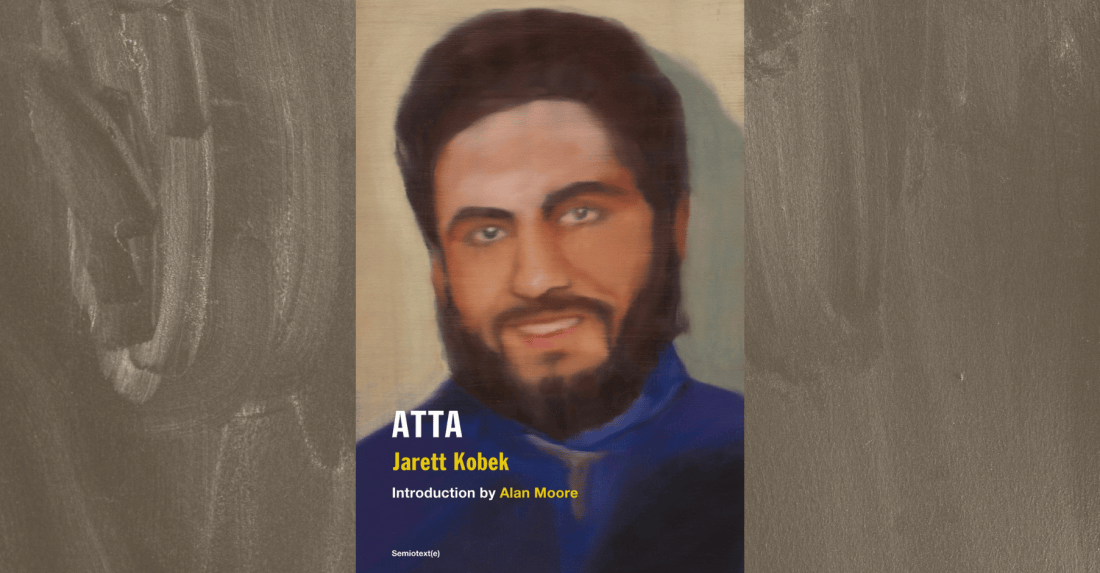
25 years ago, Mohamed Atta piloted American Airlines Flight 11 into the North Tower of the World Trade Center.
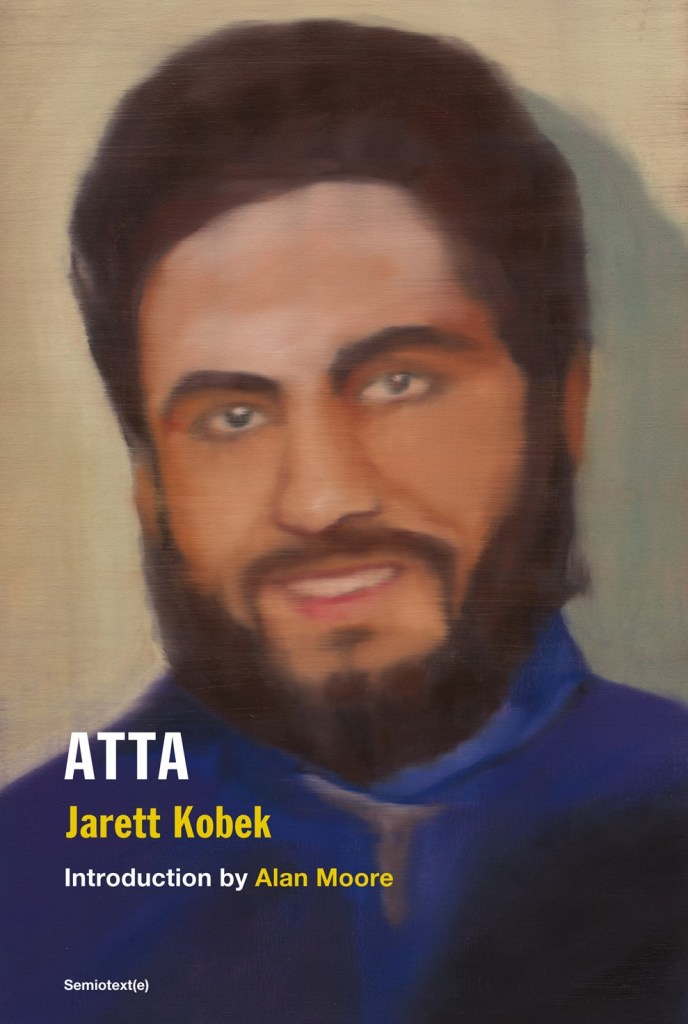
15 years ago, Semiotext(e) published one of the best novels of the 21st century: Jarett Kobek’s ATTA.
I say best not only because ATTA is superbly crafted but maybe more importantly because it showcases the most interesting aspects of the novel as an art form, the ambiguous slippages inherent to it.
In 1983, in her televised conversation with John Berger, Susan Sontag attempted to define this slippery allure when she said:
There's a kind of ambiguity in the very notion of storytelling. On the one hand, we think of storytelling as a truth-telling activity. Tell me the real story. We think of stories as bringing information. We think of stories as revealing secrets […] but we also think of stories as that's only a story, or don't tell me stories, meaning don't tell me lies, and don't you think at the very center of the whole enterprise of storytelling there is the fact that storytelling is an activity that faces in two directions? On the one hand, it's connected with an idea of truth. On the other hand, it's connected with an idea of invention, imagination, lies. One is thrilled by the story precisely because it describes something that can't happen.
The “can’t happen” aspect of ATTA is rather obvious. Mohamed Atta died on 9/11. He did not leave any journals behind. His so-called suicide note was not a personal letter but rather a standardized operational text used by multiple hijackers. On one level, we can’t know Atta, but yet, there is so very much to know, if only you are brave enough to look, to go past the supposedly clean lines of journalism and into the murk of fiction.
I’ve always been more interested in slippages than clean lines. I love blurring. I love texts that slip from one genre to another, and novels, in their highest form, are wonderful at containing and exulting in the rich ambiguity of facing in two directions. This is part of why I love ATTA so much; it is a fantastic example of the tradition of slip genre novels.
It’s hard to say exactly where this tradition begins. You could make an argument for Herodotus’s The Histories, although I think he was aiming for something else; the text itself does slip between fact and fiction, but I’m not sure that Herodotus meant it to be read in that way. One of the best early examples of intentional genre slippage is The History of the Valorous and Witty Knight-Errant, Don Quixote of the Mancha. Of course, Cervantes was doing something quite different from both Herodotus and Kobek — he was dressing his novel up as nonfiction — but stay with me because I think we can draw a useful line from Cervantes to Defoe to Diderot to Twain and on to Kobek.
In 1719, we get The Life and Strange Surprizing Adventures of Robinson Crusoe, of York, Mariner: Who lived Eight and Twenty Years, all alone in an un-inhabited Island on the Coast of America, near the Mouth of the Great River of Oroonoque; Having been cast on Shore by Shipwreck, wherein all the Men perished but himself. With An Account how he was at last as strangely deliver’d by Pyrates. Written by Himself — again, a fictional narrative presenting itself in the form of nonfiction. In 1805 we get Rameau’s Nephew, or the Second Satire, written by Diderot around 1769 but only posthumously published (in German, translated by Goethe). And in 1896 we get Mark Twain’s Personal Recollections of Joan of Arc, by the Sieur Louis de Conte (speaking of blind taste tests, when Twain first serialized this novel, he did not attach his name to it at all, asking that it be published in Harper’s as simply a translation of the writings of Sieur Louis de Conte, whose initials are identical to Samuel Langhorne Clemens.)
Rameau’s Nephew and Personal Recollections of Joan of Arc are the most salient predecessors of ATTA for the ways in which they slip between genres, deal with the lives of real people, and form a dialogue with the writer and reader. Unlike Don Quixote and Robinson Crusoe, Rameau’s Nephew and Recollections Joan of Arc take on the lives of real, and in the case of Joan of Arc, well known, human beings.
All books are a dialogue between the writer and the subject(s). Even when the writer is doing their best to hide themselves within the most strictly journalist text or the most fantastically fictional novel, the author is there, in dialogue with the subjects, in every word choice and every sentence. Rameau’s Nephew makes this dialogue obvious. Diderot is one of the two main characters. He goes for a walk and bumps into the nephew of the composer Jean-Philippe Rameau. The book is a conversation between Diderot — Moi (me) — and Jean-François Rameau — Lui (him). The result is an indictment of the corrupt, decaying French aristocracy and the milieu that surrounds them twenty years before the revolution. Diderot lays bare the venality, ignorance, and self-interest of the culture he is living in and of Jean-François whose voice dominates the novel. Diderot also gives us many wonderful lines like “The important thing is to keep the bowels moving freely, agreeably, copiously every night. O stercus pretiosum!” and “For me, my thoughts are my prostitutes.”
ATTA is freed of the “truthful” trappings and stagecraft present in its forebears. Thankfully, Kobek has not set the book up as a confession or as the diary of either Atta or anyone near to him. And though Kobek doesn’t bump into Atta at a café and spend the evening debating him, the book is nonetheless structured as a kind of conversation between Mohamed Atta, Jarett Kobek and the reader. In “A Brief History of Consciousness,” James Woods argues that written consciousness has developed over time from an outward soliloquy to a scrutinized privacy. He posits that in the Old Testament, King David has no private consciousness. We only have access to his inner thoughts when he speaks them out loud to God. Macbeth also soliloquizes out loud, but he is not speaking to God, he is speaking to the theatre audience in a kind of “publicized privacy.” Raskolnikov, Wood argues, represents a “scrutinized privacy.” Raskolnikov is being watched by us, the readers, but we are invisible; we have replaced God and the public audience.
In ATTA we are no longer invisible. We are a part of the conversation. On page two, Atta instructs us, “Put this book down. Close your eyes.” He tells us that if we fail to follow his instructions, we will forfeit “any hope of true understanding.” He walks us through a process meant to acclimatize us to his consciousness, his point of view. We must become subsumed within it, overcome by it, just as he is overcome by the sound of buildings talking. He comes under the influence of something larger than himself and we come under the influence of him. For me, the moment that it happened I was completely and totally hooked. I love to be overcome by a book; it is one of the best experiences I can think of.
In ATTA however, the moment we are fully overcome, we are pushed away. The first chapter, chapter “eight,” is followed by chapter 8. Eight is a dialogue between Me and the reader. 8 steps back into the territory of “scrutinized privacy.” It is a dialogue with Him. Imagine chapters of Notes from Underground interspliced with chapters from Crime and Punishment, the overwhelming intimacy of “I am a sick man” set against the clinical distance of “a young man came out of the garret.” And it works, brilliantly, I am utterly moved by the technique.
ATTA is a book about architecture, and it succeeds because of its own intricate and precise structure. The text is made up of a total of eight couplet chapters (8 doors of Jannah, the four Bearers of the Throne who on the Day of Resurrection will increase to eight). The book counts backwards from “eight” (first person) to “8” (third person) to “seven,” “7” and so on until we reach zero (first person flight into Ground Zero). The digit chapters begin with Atta’s arrival in Newark on June 3, 2000 and follow him through the 465 days leading up to 9/11.
The alphabetic numeral chapters begin with one of Atta’s earliest memories and extend through his childhood and university days to his years in Germany, his stay in Aleppo, his Hajj, travels to Afghanistan, Vegas, and finally the North Tower. The text is all written in present tense and culminates in four pages of zzz ZZZ ZZ z zzz zZ ZzZZ Z zzzz z zzz ZZZ ZZ z zzz zZ ZzZZ Z zzzz z (the eleventh letter of the Arabic alphabet is ز, with a voiced sound of “z,” which descended from the Semitic abjads where it represented the idea of a weapon), followed by an excerpt from Atta’s architectural thesis which he defended at Hamburg University of Technology.
The structural precision is not only noticeable in the macro framework of the book, it also extends to the level of the sentence. From the first line, I am drawn in by the grammar which immediately telegraphs a voice and a whole personhood while also managing to sum up the conceit of the entire book. Look at this:
“The first memory may be real, is possibly false.”
That is a description of this book in a nutshell. It also perfectly encapsulates Atta’s internal interrogative process, his looping mind that is always seeking truth and finding instead slipperiness. It is also simply an acoustically perfect sentence — the hard, flat, fast rhythms of the, first, may, be, real, is, false broken up by the polysyllabic memory and possibly which visually mirror each other with their y endings and thematically mirror one another because memories always contain a fair amount of the possibly false.
ATTA is Kobek’s first book. Just sit with that, with the fact that he achieved something so precise on both the micro and macro level in his first published book.
The preciseness matters because of the fact/fiction slipperiness of ATTA, a book not only about a real person but also about one of the most widely scrutinized events of the 21st century. In this context, one can’t help but ask questions like, Was Mohamed Atta actually haunted by architecture? Did he hear the voices of buildings? Kobek has said that ATTA is 95% fact and 5% invention, but that doesn’t really matter to me. Although I will admit that I can be pulled in by the magnetic thrill of “the real” just as much as anybody, it is not some outside corroboration that will ultimately make it feel genuine for me, but rather the convincingness of the writing within the book itself. Was Atta haunted by buildings? I don’t know, but I believe that he was because Kobek made me believe by writing these sentences:
“The false souls of this world call it the mains, the 50-to-60 hertz waveform of electricity running through your home. Theirs is the great lie, a Zionist deception. The humming is found in Syrian villages and in Khalden, far from the glare of a lightbulb. You can hear it with your neck beneath the boot-heel of the Great Shaitaan. And in Germany, in Prague, in Spain and, yes, even too in my own Masr, my Egypt.

This is not the noise of electricity.

This is the sound of buildings talking.”
Kobek is far from the first writer to, as Natasha Walter puts it, take the “leap into the terrorist mind,” but he is one of the few who does it well. In 2006, shortly after the publication of John Updike’s Terrorist, Walter summed up the recent fictional efforts of Updike, Salman Rushdie, and Martin Amis as attempts to “flesh out a troubling emptiness — what drives people to want to kill us.” I find that at least in the case of Updike and Amis, these attempts fall remarkably flat. I won’t take up your time with my critiques of Terrorist, a book I couldn’t even finish reading, but we should examine Amis’s short story “The Last Days of Muhammad Atta.”
Amis’s story, published in The New Yorker in April 2006, begins with Atta waking up in his hotel room on September 11. The first page attempts to set the scene in the budget hotel (which Amis has curiously changed from the real Comfort Inn to a fictional “Repose Inn”) but it is hard to see either the hotel or Atta himself through the thicket of ten-dollar words (“laconically,” “abstemiously”). On the second page things get worse as we follow Atta into the shower where he “spent an unbelievably long time trying to remove a hair from the bar of soap.” Unbelievably — who judges the amount of time that Atta spends trying to remove a hair as “unbelievably long” — Atta himself? No, it is Amis who sees it as “unbelievably long,” Amis who is standing in that shower between me and Atta, blocking the way with his descriptions of the “clammy caress” of the shower curtain.
If you push on through this paragraph you will be subjected to the sentence, “Next, as sometimes happens in these old, massive, and essentially well-intentioned and broad-handed hotels, the water gave a gulp and then turned, in an instant, from a tepid trickle to a molten blast; and as he struggled from the stall he trod on a leaking shampoo sachet and fell heavily and sharply on his coccyx.” Again, I have to stop reading to ask who is seeing the hotel as “well-intentioned and broad-handed”? Certainly not Atta who hated American buildings in general and maybe hotels specifically. So why is Amis there in that bathroom, standing up for the intentions of the Repose Inn? I don’t have an answer except for the fact that Amis could not get out of his own way.
42 years before The New Yorker published Amis’s ham-handed attempt at peering inside the mind of Mohamed Atta, they published Eudora Welty’s incredible deep dive into the terrorist consciousness of the killer of Medgar Evers. Like ATTA, Welty’s “Where is the Voice Coming From?” succeeds through the deployment of precise language. The story begins:
“I says to my wife, “You can reach and turn it off. You don’t have to set and look at a black n***** face no longer than you want to, or listen to what you don’t want to hear. It’s still a free country.”

I reckon that’s how I give myself the idea.

I says, I could find right exactly where in Thermopylae that n*****’s living that’s asking for equal time. And without a bit of trouble to me.

And I ain’t saying it might not be because that’s pretty close to where I live. The other hand, there could be reasons you might have yourself for knowing how to get there in the dark. It’s where you all go for the thing you want when you want it the most. Ain’t that right?”
This voice is terrifying and utterly convincing not so much because of the obvious aspects like the use of horrific epithets but because of the driving force of it, the depravity lurking in the rhythms and repetitions, I says, I reckon, I says, And I ain’t saying, and the sliding between I and you — there could be reasons you might have yourself for knowing how to get there in the dark. While I know that Welty is there in each sentence, she is the reason the sentences leap at me, but she has also gotten herself out of the way, she is not standing between me and the terrorist, she is pushing me closer and closer to him with each word.
Welty wrote her first draft of “Where is the Voice Coming From?” the day after Medgar Evers was murdered in Jackson, Mississippi where Welty also lived. The story was published a month later, before Byron De La Beckwith Jr. was announced publicly as the main suspect in the case. Welty had no way of knowing the exact identity of the murderer, but she got so many details correct that The New Yorker actually edited the story after De La Beckwith’s arrest to avoid legal troubles.
Welty said of her drafting process that she was “trying to discover who did it, [not the] name of the murderer, but his nature.” It was the writer’s job, she said, “to be able, to be ready, to enter into the minds and hearts of our own people, all of them, to comprehend them (us) and then to make characters and plots in stories that in honesty and with honesty reveal them (ourselves) to us, in whatever situation we live through in our own times: this is the continuing job, and it’s no harder now than it ever was, I suppose. Every writer, like everybody else, thinks he’s living through the crisis of the ages. To write honestly and with all our powers is the least we can do, and the most.”
I don’t agree that this is the job of every writer. Some writers spend all their writing lives simply trying to comprehend themselves and that’s fine, but I do personally love a text where a writer meticulously and convincingly ventriloquizes someone else’s dark mind. There is a certain audacity in this act that I admire, the audacity of going so deep and so dark and convincing me to go there with you.
In “The End of the Novel,” Osip Mandelstam wrote that “the novel was perfected and strengthened over an extremely long period of time as the art form to interest the reader in the fate of the individual.” Mandelstam saw the novel as a direct descendant of the tradition of the sacred hagiography, where the individual life of a saint provided a narrative template centered around a singular, highly significant internal journey. In the novel, spiritual salvation is replaced with the uncovering of psychological motivation. This is where I want to suggest a reading of ATTA as a 21st- century hagiography while simultaneously admitting that I may have been spending too much time with my own mind.
I should have stopped writing this review a long time ago. Maybe it’s not even a review. I should be focusing on revising my own novel. But I am living alone for the first time in a long time, and my mind keeps looping everything back to ATTA. I’ve taken to writing each afternoon in St. Patrick’s Cathedral. I am not religious, but the church is a great semi-private-semi-public space in which to follow my thoughts in circles or, as Diderot said, “let my spirit roam at will, allowing it to follow the first idea, wise or foolish, which presents itself, just as we see our dissolute young men on Foy’s Walk following in the footsteps of a prostitute with a smiling face, an inviting air, and a turned-up nose, then leaving her for another, going after all of them and sticking to none.” And after a while, my thoughts are happily interrupted by one of the seven masses that occur throughout the day. A woman with an extremely thick Bronx accent sings slightly out of key and then the priest essays on longing and betrayal. Man is a vessel of longing, he tells me, bent always toward betrayal.
It is Kobek’s portrayal of Atta’s longing that has haunted me the most.
Atta as a child in Cairo, listening to the buildings talking, attempting to draw a picture of his family and his home when he is overcome, his hand moving
“as if under the influence of a malicious jinn. I look to my family, but they pay no attention. Mother cooks, father reads, sisters study. They do not hear the sound of my furious hand. The volume of the scratching sound—shhh shhhh shhhhh shhhh shhhhhhhhhhh—grows until it deafens.

I lose the world. No sight, no scent, no touch, no flavor. Only the sound. The sound of humming. I listen for an infinity, without beginning or end. The humming stutters, becomes a rhythmic beating. Boom boom boom boom, like a heart pumps blood. This is no heart.”
Atta in Hamburg sublimating his intense loneliness into a hatred of the Tele-Michel and an uncontrollable urge to buy women’s cosmetics.
Atta unable to handle the attention of an intelligent woman.
Atta at the end of his Hajj, feeling nothing.
Atta drawn magnetically to Disney World and the capitalist/terrorist fantasy of Talespin.
I will likely never stop thinking about Atta and his longing.
There is only one misstep in all of ATTA and that is the inclusion of “The Whitman of Tikrit.” The book is sold as “a novella and a short story,” but for all of its slimness, ATTA does not feel like a novella, it feels like a novel, and the inclusion of the story, “The Whitman of Tikrit” is simultaneously too much and too little.
After reading ATTA I needed space. I needed to think and walk and reflect but the existence of “The Whitman of Tikrit,” right there on the following page, was too tempting. I read on. I wish I had not. “The Whitman of Tikrit” tells the story of Saddam Hussein’s last day before capture by American forces on December 13, 2003. I don’t wish that I had never read “The Whitman of Tikrit.” I just wish I had not read it immediately on the heels of ATTA. I also wish I could read an expanded version of it.
Kobek uses similar techniques in both texts, although “The Whitman of Tikrit” is told entirely in third person. It is fascinating, exploring Hussein’s, or The Tyrant’s, obsession with Walt Whitman, his writing of romance novels, his rise from absolutely nothing to absolute power. “The Whitman of Tikrit” is a wonderful piece of writing, I just wish it had been given room to breathe. I of course understand the historical beauty of putting Atta and Hussein’s hagiographies side by side in one book, but I still wish “The Whitman of Tikrit” had been published as a follow up instead of being sandwiched in. Maybe in another 15 years we can get a reissued, expanded version of The Tyrant’s story.
In the introduction to this reissue of ATTA, Alan Moore argues that Kobek’s follow-up novel, I Hate the Internet, and perhaps the rest of Kobek’s writing career have been fueled by the “lack of response” to his “opening thunderclap.” Moore warns us not to overlook the reissue of ATTA for fear of what insanity Kobek might unleash in response to being ignored again. This threat sounds so great it almost makes me want to tell you to make good on it, except that I know that Kobek doesn’t need silence to inspire his genius, he has already written Gun Violence in America. It comes out next year. Kobek doesn’t need your silence for fuel. You are only hurting yourself if you aren’t reading ATTA.
FICTION
Atta
By Jarett Kobek
Semiotext(e)
Published September 15, 2026


