
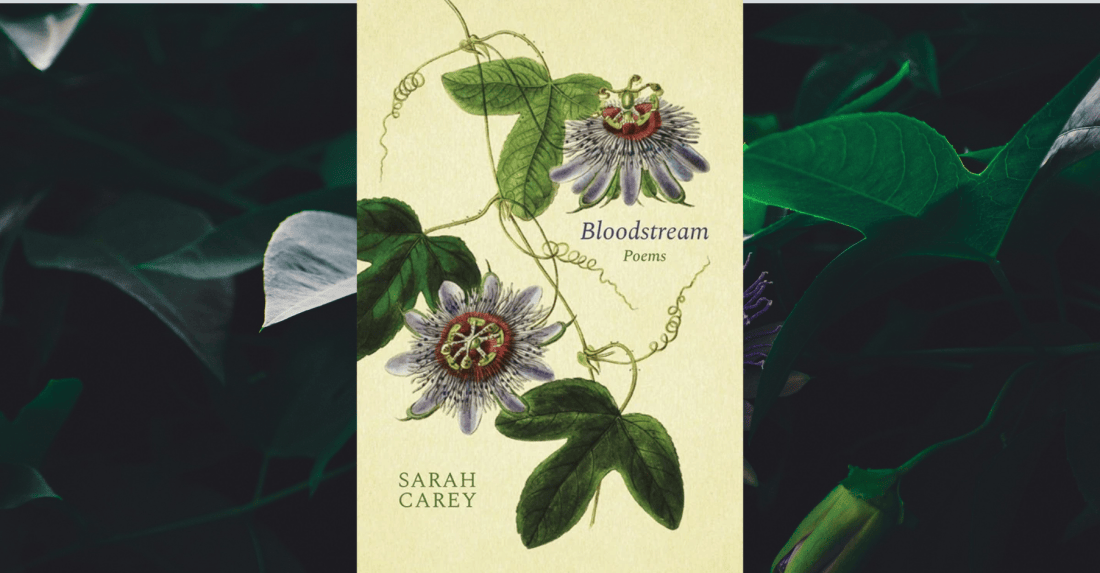
In Bloodstream, Sarah Carey’s second collection of poetry, the poet offers a moving exploration of the core elements that bind us: lineage, grief, and nature. Carey leads readers deep into the terrain of family history and memory, illustrating how we carry our relationships and experiences along our personal paths. Throughout the collection, she reminds us that identity is composed of far more than physical DNA; it is equally shaped by our habits, our surroundings, and our losses.
Carey structures the collection around the evolving concept of identity and how we adapt over time, organizing the book into six distinct sections: “Who We Were When Others Couldn’t See Us,” “One Day’s Inventory,” “Another Day’s Inventory,” “Breath,” “Another Day’s Breath,” and “I Revisit What Comes to Me.” In each of these sections, Carey chronicles how we are shaped by time — who we used to be and how it feels to watch loved ones grow old; memories — day-to-day accounts of what it means to live as a family; and loss — grief is a constant visitor.
Across these sections, grief remains an abiding presence. The loss of a parent serves as a permanent marker threaded through many poems. Carey’s treatment of memory echoes writer David Shields, who suggests that memory consists of what we construct and feel rather than an exact video replication of an event. Carey reinforces this concept by demonstrating that grief is not something to be conquered or “overcome,” but a reality to be lived alongside. In “I Revisit My Father’s Rooms in Anchorage,” she recalls her father’s physical space and demonstrates how blood, time, and recollection bind us across distance:
I freeze-frame the glacial way he’d rise

from his recliner, brace against his walker to greet me—

when, in his day, he’d crave a ticket anyplace
Beyond human lineage, Carey repeatedly links our physical mechanics with the surrounding environment — coastal flora, wild birds, and shifting weather patterns. She asserts that the natural world is not merely a setting, but an integral part of who we are. Just as returning to familiar woods or the ocean brings a sense of recognition, nature greets us with an enduring history. In “Seasonal Affective,” Carey uses vivid sensory detail and color to mirror the recurring cycles of loss: “Father’s voice booms in on the second ring, as if he never stopped speaking.”
These lines illustrate how grief continuously surfaces; we are visited by those who have passed as though they remain beside us. Carey continues:
When the chill penetrates our bones,

we pack our bags, meet spring on a beach,

where we let the waves

touch us gently, then recede.
Much like the tide, memory temporarily restores the dead to the present in a brief embrace before drawing back, leaving us grounded once more in reality.
Throughout Bloodstream, landscape runs parallel to human pain. Just as hikers navigate difficult terrain laden with pack weight, a grieving individual carries the weight of loss and heritage — a burden that irrevocably shapes their journey. Carey mirrors this theme through form; her use of rhythmic cadence and fluid enjambment creates a sense of lyrical circulation.
Ultimately, Bloodstream maps a deep vein of realization. Carey shows that while escape from grief is impossible, embracing what shapes us brings its own quiet solace. While we cannot choose our lineage or evade loss, those experiences do not trap us — instead, like blood in a vein, they become a vital force that sustains us and carries us forward.
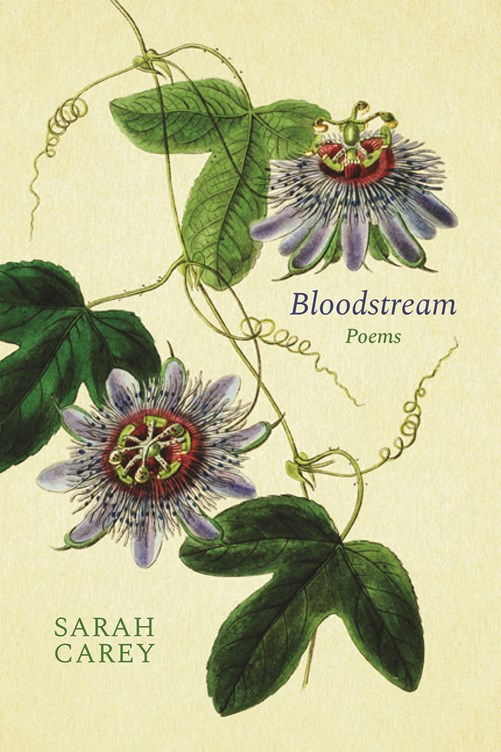
POETRY
Bloodstream
By Sarah Carey
Mercer University Press
Published February 3, 2026


