
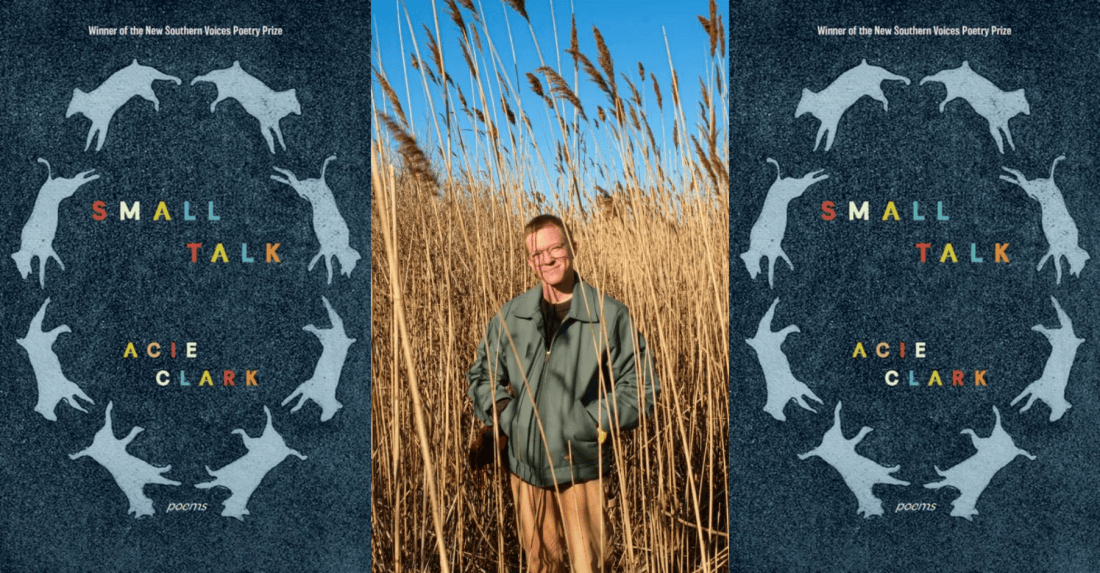
As a poet that embraces nature, religion, and the ordinary world in my own work, I was elated to have the opportunity to interview the author of Small Talk, Acie Clark. In this collection, Clark takes conversations about everyday topics (such as weather, work, and walks) and brings them into deeper conversations on identity, connection, and what the things of the world truly mean. Small Talk flows through the subjects of family, spirituality, transitioning, recovery, and being queer in the American South.
Acie Clark is a multi-genre writer from Florida and Georgia. He received his MFA from the University of Alabama and he has taught at the University of Central Arkansas, Interlochen, the Provincetown Public Library, and as a mentor with SUNHOUSE. His work has been supported by the Fine Arts Work Center and the Collegeville Institute, selected for Best New Poets, and anthologized in Divinity in the Margins, I Witness, and The Florida Anthology. His debut collection, Small Talk, was selected by Derrick Austin for the New Southern Voices Poetry Prize from Hub City Press. Recent work is or will be published in Adroit, Strange Hymnal, the Louisville Review, and 14 Poems.
This interview was conducted via email with the author, Acie Clark.
Your titular poem(s), “Small Talk” happen throughout this collection. What brought this about? What statement do they serve as within the complete framework?
This book began quietly. At the time, my voice was changing — both metaphorically and literally. I had been on testosterone for about six months and I was about 60 days sober, and with these changes came a realization that I had new things to say and I simply did not know how.
This was at the end of my MFA and I had been feeling stagnant in my writing practice. I didn’t have one. The way I saw it, I wrote when I had time but that time hardly ever seemed to materialize. On a lark, a friend and I agreed to write a poem every day for a week. The constraint I gave myself was that every line had to start with something about my coffee and something about the morning so far. I figured beginning with the mundane would make it so that I didn’t feel any pressure to make the poems good, just to make them at all. I think of those poems as the beginning of this project; the moment I began to write a new kind of poem because I was writing in a new way and with consistency.
It didn’t occur to me until fairly late in the process to spread out the “Small Talk” poems, which had originally been a multi-part poem, and what that might do for the collection. I placed them throughout the book so that they could offer a kind of starting point for the “conversation” each section was having, a sort of come on in! for each arc.
Many of the poems in the collection use repeated words/verbiage within a poem, such as in “All summer the foxes,” there is:
From this self I watch this world burning, see my place
in human history, see the men I am from
setting forests on fire for the men who hired their bodies
to do what the State claimed God decreed, closing
their eyes so they couldn’t see themselves setting themselves
on fire, setting on fire the future, names like ash in the wind,
ash in my mouth as I try to name what isn’t known: unnamed
by not knowing how to remember to mourn.
What brought about this style within your poetry?
As far as origin goes, I didn’t grow up with books of poetry around. The two contact points I had for poetry were through church and folk music. I’m grateful; both taught me so much about musicality and structure. I came to understand how time could be enacted through form and how repetition acts on the body. When I eventually encountered words like affect and somatics, I felt like I was learning language for something I already had a bodily sense of.
I really love this phrase Frank Bidart once wrote, and how Garth Greenwell has elaborated on it, this idea of “magpie beauty” to describe how poets are always finding images and approaches to borrow from the world for this work. I spent a lot of time reading mystics from different spiritual traditions during this project, and I found the language tactics — repetition, for sure, and negation and a piling up of tenses — I learned from these writers profoundly useful when attempting these poems. I also live in a place where they roll up the sidewalks around 9 p.m., and the train can be heard passing through at regular intervals, and tornado sirens signal that it’s Wednesday again. I’m always collaborating with these kinds of details; I am excited by the ways the ordinary leads us to the metaphysical, and the particular kinds of music a certain kind of quiet makes possible.
You often mention nature within these poems. What would you say that you identify most with in nature and why?
Oh, that’s a beautiful question. I’ve spent the last few years thinking a lot about my relationship to being of nature when I’m out in it. Most days start with a walk with my dog, ideally as out in it as possible, and then I’ll sit down to write. I want to be in the quiet that can be found outside, which is of course not quiet at all. I try to get to water as often as I can, whether that’s a creek or the ocean or a lake, and to place my hand against the trunks of trees as I pass them. I think it’s about scale, about larger timelines, about feeling both insignificant and part of something vast. But I guess I’ve avoided the question — to pick one, just for now, beauty berry is a favorite of mine here in Arkansas. The berries are some of the first color of the fall and they stay through the start of winter; they don’t taste particularly good (to me), but the birds love them.
I loved the poem Prophecy in your collection. After reading it and poems like “Let’s Stay Gay in Alabama” and “Faith Hill,” I wondered how you balance the impact of religion and religious beliefs/judgement within the South. As a member of the LGBTQIA+ community myself who was raised in the South, I know that this can sometimes be complex. How do you navigate this?
Thank you for this question and thank you for sharing that! I love the South and I am proud to be a Southern writer, and while I don’t necessarily identify as a Christian now, I was raised in that faith and I have a lot of gratitude for how it shaped me. That said, I think love and reckoning require each other.
There’s been a strategic and longstanding weaponization of a certain understanding of “Christian values” against the LGBTQIA+ community. Of course, this exceeds a difference of belief or opinion — it affects the material realities of people’s lives. Recent legislation, at all levels of government, has significantly impacted the civil liberties and rights of trans people. It’s also important to name that Christian nationalism and prosperity gospel have a long history as a tool of white supremacy and that persists today.
Of course, no religion or group of people is a monolith. I have been so heartened to see the organizing work done by churches across the South to fight against oppression and hate. I want to honor the mutual aid that happens across the South, and the organizations that are doing essential work, like Intransitive here in Arkansas. All this to say, I’m in the choir calling for a more elaborate understanding of the South, particularly for people who aren’t from here or have never been here.
In my daily life I try to navigate alongside the people I love, and poetry is where I go to find language for it all. I am always coming into new language for what I believe, just like I’m still coming to language for how I think about queerness or transness or love or belonging or hope. There are a few poems that are like prayers to me, that I’ve memorized, that I hold that close. Lately, I’ve been so grateful to find Saretta Morgan and Chrysanthemum Watkins’ work, and I’m always reading C.D. Wright and Naomi Shihab Nye. They’ve all given me so much to think with and about this last year.
On the subject of religion, I view this collection like a testimony. It is you working through your feelings and thoughts; you mourning and finding a discovery of self. Do you view your poetry in this way?
It’s such a powerful word that I might’ve hesitated at one point to say yes, but yes. I think about Carl Phillip’s essay, “A Politics of Mere Being,” where he states, “To be alive has never been one thing, any more than a period of history is.” In writing this book, I wanted to avoid limiting the scope of my I, though of course that happened by virtue of the fact that the book had to end at some point. This book gave me permission to both change and to archive that change, and I’m still finding change when I revisit these poems — now as a reader!
Your mother is a feature of many of these poems, such as in the complexity of the relationship defined in numerous ways. Have you always been able to write about your relationship with her with such depth and understanding?
Among the most important gifts of my life are two lessons I credit my mother for teaching me. The first lesson is to always consider another person’s perspective. Of course, I resented this as a middle schooler being asked to consider, say, a bully’s interiority, but over time it became something that helped me to see a larger scale of interconnectedness, of cause and effect. The other lesson is that people can choose to change — someone can hurt you, you can forgive them, and they can choose to be different in the future — and also, they may not.
I used to be much more afraid to write about ideas I wasn’t sure I could handle; the fear of not getting it right would keep me from trying at all. Working on this collection was a series of first attempts and then many, many, many revisions. I so appreciate your wording in this question; that was my hope, that I could talk about these things with depth and understanding, to make a sense of it. I’m grateful to my mother for providing me with some of my most beloved tools.
Your series of “Temperance” poems are some of my favorites. What brought out this series of poems for you?
I went through a moment where I was titling most of my poems “Temperance.” I think most of the titles in this book could be substituted for Temperance. It is one of those words that is so expansive, for all it constellates, for the different connotations and meanings in different rooms. I wanted to play into that multi-meaning nature, but ultimately, in the collection, the poems titled Temperance are the ones where the speaker is attempting the posture of the tarot card: a foot in two realms, a hand on both cups.
You recall childhood in several of the poems, like in “See Rock City,” “To return to those early prayers,” and “Absolution online.” What fuels your use of childhood? Do you view it as an important part of who you are today?
In the early stages of working on this collection, a central part of my meditation practice involved seeking out my inner child and trying out what it felt like to have a conversation. This often looked like answering questions, or offering revisions to narratives I had long held. Just like all the conversations I was having during this time of my life, these talks found their way into the poems.
As a trans person, I am so grateful for the ways in which poetry can act as a speculative space. I am grateful for experimental poetry and the trans poetic tradition, which offered me so many tactics for how to speak not only with multiple voices but from within multiple realities and selves. I had a girlhood, and I celebrate that part of my history, but poetry has given me a space where that child I was can also be affirmed in the boyhood they understood themselves both to be having and not able to have. In the poems, all of these versions of that reality get to coexist as true.
What do you hope that readers ultimately receive from this collection?
Before it came out, Rebecca Gayle Howell offered that Small Talk was a prayer book. This language was a real gift. I wanted to find new ways to talk about what is often thought of as unremarkable. I hope when people read this book, they think to call their friend. I hope that this book keeps people company.
Thank you so much to Acie Clark for providing such thoughtful responses in this interview!
POETRY
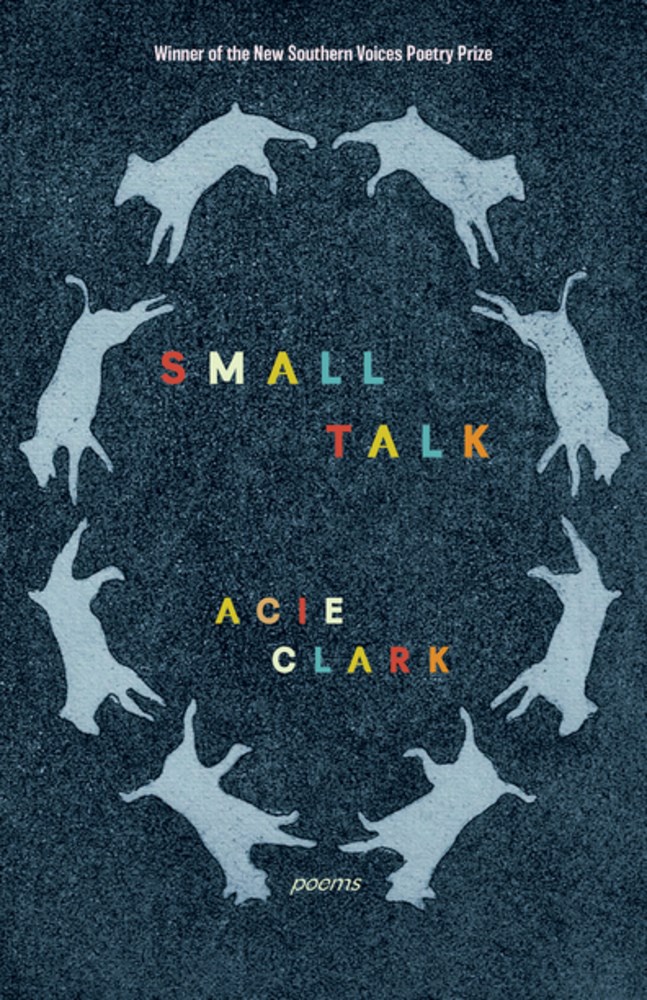
Small Talk
By Acie Clark
Hub City Press
Published September 22, 2026


