
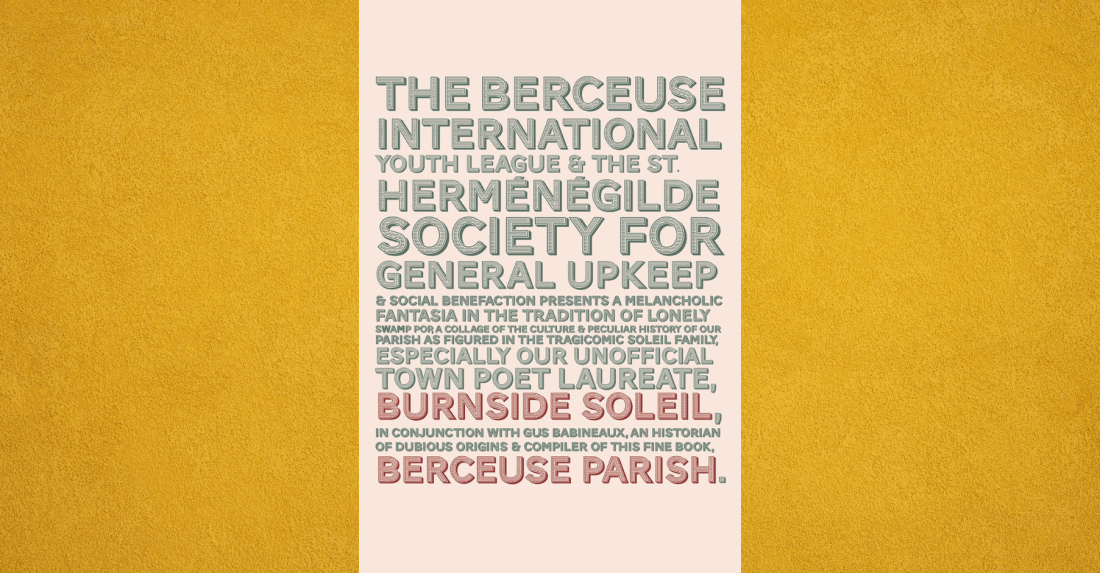
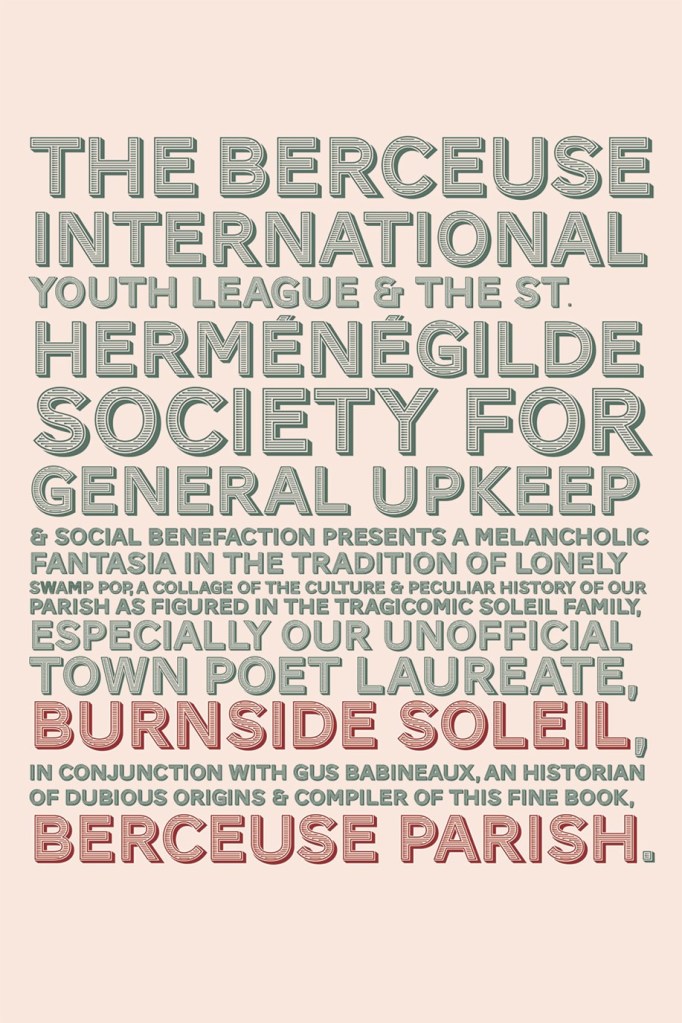
Reader, you deserve the garrulous title of Burnside Soleil’s debut poetry collection in all its glory: The Berceuse International Youth League & The St. Herménégilde Society for General Upkeep & Social Benefaction Presents a Melancholic Fantasia in the Tradition of Lonely Swamp Pop, a Collage of the Culture & Peculiar History of Our Parish as Figured in the Tragicomic Soleil Family, Especially Our Unofficial Town Poet Laureate, Burnside Soleil, in Conjunction with Gus Babineaux, an Historian of Dubious Origins & Compiler of This Fine Book, Berceuse Parish.
If a title is a window into a book’s interior, the front cover of Soleil’s debut poetry collection is a wide-open door with music pouring out. We are told, in a rush of maximalist text, that we are about to encounter the melancholic, the traditional, the dubious, and the peculiar in the form of a collage, a fantasia, and a fine book. (We also see Herménégilde Chiasson, acclaimed Acadian poet, sainted.) And even though Berceuse Parish builds layers of artifice to keep the reader from reaching for “true facts” about the poet, it does remain true that this is a fine book. It’s a sincere love letter to childhood friendships and cousinhood, a lament for leaving parents, a field guide to Louisiana wildlife, and a celebration of the multiplicity and, yes, tragicomedy, of contemporary Acadian life, where Soleil represents the present pressing up against the past.
Berceuse Parish keeps to a consistent navigational structure. Each part is introduced with a short epigraph attributed to a “Traditional Acadian ballad.” The names of family members and friends of Burnside Soleil serve as the titles for all of the poems; we’re given a cast of characters after the table of contents to keep track of these relationships. Soleil’s poems are mostly written in the second person — each poem an address to the beloved in the title. Also in each part: a pair of epistolary poems, letters between “Penny” and “Uless/Vaut-Rien” (“Good-for-Nothing” in English, a footnote from Babineaux tells the potentially monolingual reader). These Odyssean figures are Soleil’s parents — Uless, who leaves for Colorado to herd sheep, and Penny, who later leaves Soleil and his sister to grow up around his cousins Nel and Micah with their grandparents. Finally, every other poem or two, prose interludes, attributed to historian Gus Babineaux (a fabulation of Soleil’s), always titled “A Few Particulars on ______,” serve as extended prose poems and historical explanations of family lore, narrativized as the underpinning for the more imagistic and nostalgic poems from Soleil.
I find the Babineaux sections particularly brilliant. Gus Babineaux, as a character, acts as both a genuine archivist of tidbits and stories of Berceuse Parish while not being so concerned with the absolute verifiability of everything he says — very endearing and familiar to this reviewer, raised around brilliant rural historians of the hyper-local. In “A Few Particulars on Courtship,” Babineaux reprimands the “tourist” looking for “cultural kitsch” in poems about cadiens — “Do you think we know only swamps, not the mountains and rivers and snow? Read a book.” Babineaux can provide the reader with essential complicating context about Acadian life in Louisiana, which then frees the poems from having to educate outsiders. Instead, they can be addressed solely to those who already know.
“Babineaux” complicates the voice of the unbiased historian, like this conclusion about Penny: “And who knows, in the end, why she left? She pulled a Thoreau, one could argue, and out there in the wilderness, we wonder what truth she found. It’s no good to indict, though. What we do, sometimes, is just what we do.” This sentiment rings differently coming from an impartial archivist than from an abandoned child now grown. Yet the book asks us to remember there is a singular author behind both tones. Babineaux discourages the impulse to read the poet’s poems (and his histories) as fact or biography, but as art, and as shifting, incomplete family lore.
Soleil externalizes by casting Babineaux as a historian, which leaves the poems to do non-narrative work. The poems that Berceuse Parish attributes to Soleil can inhabit beauty, tenderness, and sincerity without compromise. They appear in couplets, tercets, quatrains, and free verse. They are attentive to flora and fauna — these poems are filled with moss, chrysanthemums, termites, mice, firs, snow, sugar maples, pelicans, eagles, hawks, ashes, pecans, locusts, butterweed, blue-billed ducks, sycamores, and spruces. I could go on and on. The poet and his beloveds are so often outdoors, and even the domestic poems, ones with screen doors and wood stoves, feel like they’re steps away from the humidity and outside.
All this talk about structure and character conceals the true draw of Berceuse Parish: the emotional core of the poems. Soleil’s images and addresses are rooted in longing — for the absent (and returning) lover, for the absent (and unreachable) father, for a time in childhood where two people (a sister, a cousin, a friend) shared closeness, now lost. From the last lines of “Jeremy”: “Once you kept the names of birds / in a graph notebook. / The summer we were twelve, // you stopped. There were too many. / What we need to understand / each other is often belated.” Though this feeling permeates, the poems for Rae and for Soleil’s two children also point to the possibility of future closeness. From “Frances”: “On this night, you make me kneel next // to your new bed, finding the two pillows you need for your neck, / and I tell you about a mutt loose on the levee, how I followed // him past the bricks rooting the hill of the Old Spanish Fort where I saw / an oak husk, its bark brittle eddies. We come so close to things.”
Berceuse Parish is equally fabulist and sincere, a rare combination. I tried to resist the impulse to interrogate this book for “truth” about the poet’s stories. I found myself anticipating a conflation or complication of the roles of historian and poet. What we get instead is a book that is consistent in its experiments, committed to beauty, and interested in a multitudinous way of being in the world. To end on Soleil’s language in a poem to “Uless”: “The only thing bigger than a life we imagine / is a life that exists.”
POETRY
Berceuse Parish
By Burnside Soleil
Texas Review Press
Published February 18, 2026

 Southern Review of Books