
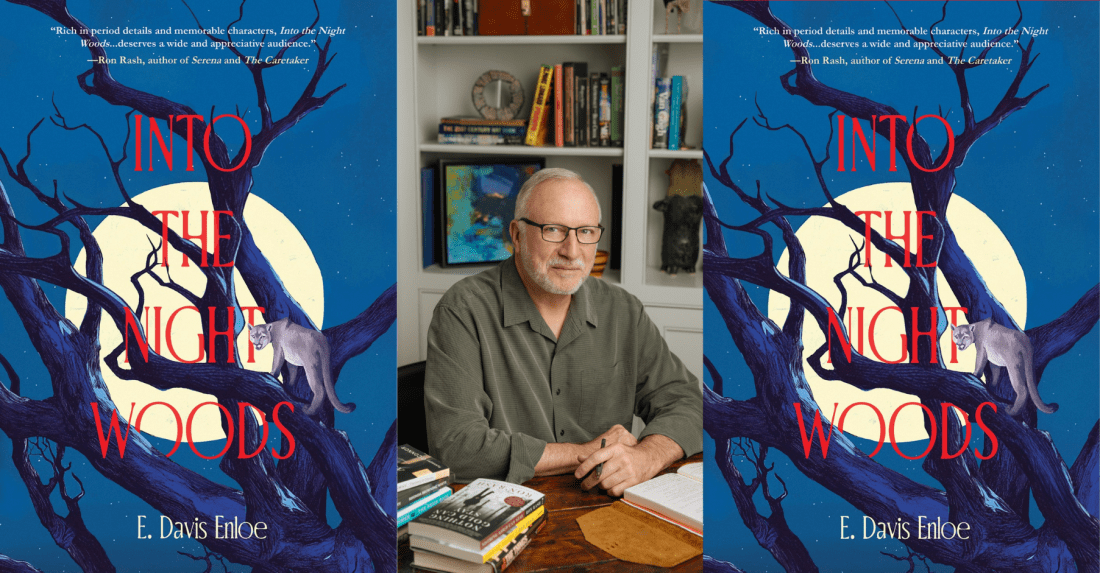
I met Davis Enloe in 2018 when we served on a nonprofit board together. It was then that I googled him and found a short story of his in Hunger Mountain about a prison guard on the firing squad of an old friend’s execution. Its rapid-fire banter and life and death stakes immediately drew me in. After reading Davis’s debut novel, Into the Night Woods, I see they’re both about complicated moral situations, ones with no good answers. In his new book, 12-year-old Boyd is sent to his grandfather’s house for the summer, thwarting his plans to search for a hidden cave with his best friend Roger. When Roger’s life is threatened by his abusive father, Boyd risks everything to protect his friend.
The crisp prose you’ll find in Davis’s book was likely honed at Converse College during an MFA in Poetry. His poems and stories have appeared in Barrow Street, Main Street Rag, Cold Mountain, Chariton Review, Broad River Review and Appalachian Review.
I spoke with Davis about Into the Night Woods through email after numerous conversations about writing over the years.
I’ve never been to Rutherford County, North Carolina, or navigated over the rotting boards and rusted steel of an abandoned trestle in the Blue Ridge mountains, but after reading this book, I feel like I’ve done these things. What strategies did you use to reconstruct the 1961 version of Boyd’s town?
The community of Gilkey is constructed almost entirely from memory. As I wrote, I always had in my mind the school, the church, the lumberyard, trestle, railroad track, etc. that I grew up around. Some places, like the bus stop and the hardware store, as well as the nursing home, I tried to imagine what they would been like in 1961 in a rural or Appalachian county. I spent a lot of time outside as a child and in and around creeks and lakes and barns and gardens, so it felt relatively natural to include those in the story. I worked hard to include as much detail as possible to help the reader see what things looked like in the early ‘60’s and what a typical day in the life of a twelve-year-old boy on a farm might have felt like. I did spend time researching the key historical events during the timeline of the story – things like the Cuban Missile Crisis and the Roger Maris chase of Babe Ruth’s homerun record.
Boyd often operates with moral ambiguity. You don’t just flirt with him making bad decisions. In order to protect Roger, he literally tries to kill Roger’s father, Earl. How did you approach writing a character whose moral framework is still forming under intense outside pressures and what ultimately guides him?
To have a compelling first-person 12-year-old protagonist, I felt it was essential that Boyd be in peril both emotionally and physically. He had to be someone the reader believes capable of committing an unconscionable act, like killing a human being, but he couldn’t be a loose cannon with no moral grounding. He had to be conflicted even as he felt he had to do what was necessary to protect his best friend Roger. This meant he had to be headstrong and reckless but fully committed to Roger’s safety.
Though I don’t think that Boyd would ever have used the word love to describe his relationship with Roger, I think he had a deep and genuine affection for his best friend. As rough and tumble as Boyd was, he was also a sensitive kid that had this strong sense of what was right and wrong when it came to how people should be treated. He had grown up around his grandfather Grange who had a strong moral fiber. I think part of what makes Boyd such a compelling character is that the reader relates to what he must be going through emotionally, that no child should have to deal with the circumstances foisted upon him.
You worked on this book over a number of years. How did the novel evolve from its earliest drafts? Were there major elements you had to let go of?
I’m a romantic at heart and have to guard against making things too precious. I had to make an effort to not save characters and to let fate decide how things worked out. I think one of the challenges was to place main characters in situations that demanded they make difficult if not impossible choices that force them to find a way out. In this way, I tried to keep a certain level of tension throughout the story.
Early on there was a plotline that involved Uncle Monk, a Korean War veteran, who was struggling with how he allowed a gay soldier to be treated while still on active duty. It became clear that storyline just wasn’t what the story was about, so it had to go. In early drafts there was more about the boys in school and their conflict with their teacher. Again, it didn’t carry the story narrative forward so those frivolous darlings had to be murdered. Clearing all that out focused the story and helped me understand what story was asking to be told.
A climactic scene toward the end of the book, where Boyd and Roger confront Roger’s father and Sheriff Muskey at the abandoned trestle, feels like a convergence point where plot, character, and theme collide in pure action and suspense. What went into constructing that scene?
Lee K. Abbott once told me that the best novels are the ones where the story that runs underneath, the emotional story, merges with the physical story, the story that is unfolding in the literal world. So, I had this strong desire to have everything: Boyd’s fear for his best friend’s life; the evil father’s intent to break his son and likely kill him‘ the grandfather’s desire to see only good in people; Roger’s desire to escape from his abusive father even as he tries to protect him. All of the action and feeling that had knotted itself into a somewhat impenetrable complication needed a way to unravel – a denouement, un unraveling of the knot. So, when I think about how I constructed that scene I believe it inevitability was written into the story as the novel progressed. I don’t know when I realized how the scene had to be written but I pretty much knew I wanted a climactic scene on the abandoned trestle.
This book reads like a classic literary adventure reminiscent of Mark Twain and Robert Louis Stevenson. What writers influenced you while you wrote?
I read William Maxwell’s So Long, See You Tomorrow because Stewart O’Nan, a writer I’ve worked with, recommended it and because at some point it became important to me to make the retrospective narrator in the story more prevalent. Because this was my first novel, I was still reading a lot of craft books, but I do know that I read all of Ron Rash’s short stories and early on read his first novel, One Foot in Eden. I think I also went back and reread Dickey’s Deliverance. I remember reading Wiley Cash’s novel, A Land More Kind Than Home and I remember going back and rereading some of the classics, like Hemingway’s The Sun Also Rises and Steinbeck’s The Grapes of Wrath because I remembered them being such well-told stories.
I’m glad to hear that you felt the book read like a classic literary adventure because it was important to me to achieve a sense of timelessness with the novel and that was largely what drove me to set the novel in a time before computers and cable TV. I wanted the reader to be transported into a somewhat distant past.
Can you tell readers about what you’re writing now? How does it relate to the thematic concerns of Into the Night Woods — particularly around childhood, moral ambiguity, and failures to protect the innocent?
Somewhere I read or saw an interview where Cormac McCarthy talked about writing about the important issues, how if the story was not about life and death, it was not interesting. This reminded me of something that the poet David Baker told me about a poem I was writing. He said it was a good poem, but when I asked him if it could be great, he said no because it lacked peril. For now, the profound issues, the peril that I want to write about seem to involve loss of childhood innocence.
In Into the Night Woods, a child is thrust into an adult world and forced to navigate this world without the experience and insights necessary. In my current project, currently titled, Still So Beautiful, I deal with child sexual abuse, and the lengths people go to avoid confronting it in their lives. I delve into the issue of how otherwise responsible adults rationalize wrongdoing in other people, but also the deadly lengths some will go to in confronting child sexual abusers. In both novels, characters have to make difficult moral decisions and, in both novels, adults have failed to protect the innocent.
I’m going to end with a question about one of your writerly superpowers: dialogue. Here’s a passage from the book:
The barn dust we’d kicked up had set off coughing fits, and we were breathing through our shirts. Sitting with his back against a bale, Roger held his hand up in a shaft of sunlight and watched the dust particles swirl around it.
“You ever think about how small we are?” he said.
“You mean small because we haven’t started seventh grade yet?”
“I mean small, like we don’t matter much.”
“Like Stinky Stan don’t much matter to nobody?”
I kept my eye on one of the wasps, a large, friskier one.
“Like this is God’s hand.” Roger twisted his own hand back and forth in the sunray. “And all these dust specks are planets.”
With Southern dialects especially, what’s your secret to writing authentic dialogue without going overboard?
I like the idea of having a “writerly superpower,” and it would be nice to someday possess such a marvelous skill. I’m not sure why I seem to do dialogue well. I remember Lee K. Abbott often saying dialogue is the most important tool in a writer’s toolbox, so I’ve always paid close attention to it. I think it has something to do with reducing the conversation down to what seems essential and doing it in such a way that it has a particular feel and sound.
When I was writing poetry, R.T. Smith once took a poem of mine and said, “A poem is shorthand. Do it this way.” He then went through very quickly and cut out all the extraneous connective stuff and the poem was transformed. What I took away from that is in poetry, as in prose writing, you need to take out all the extraneous stuff, always work to make it more concise and clearer. Dialogue seems to work best when it is a function of story action and when there is tension. But in the passage quoted here, there is no tension, but there is a rhythm created by the intercession of narration. And it moves the story forward by reminding the reader not only how vulnerable these two young boys are, but of all humanity’s vulnerability.
It feels too easy to say that dialogue needs to pull the reader in, to make them feel included by making the dialogue real and relatable, but maybe there is truth there. Having said all that, I don’t quite know how I do it, but I do know that I spend a lot of time with it, looking at, reading it out loud, and sometimes telling myself that there is no way a particular character would say something that way. I catch myself saying the same thing to a bit of dialogue I hear on TV. Maybe that implies that dialogue works best when characters are firmly established, and the reader can anticipate what and how someone will say something.
FICTION
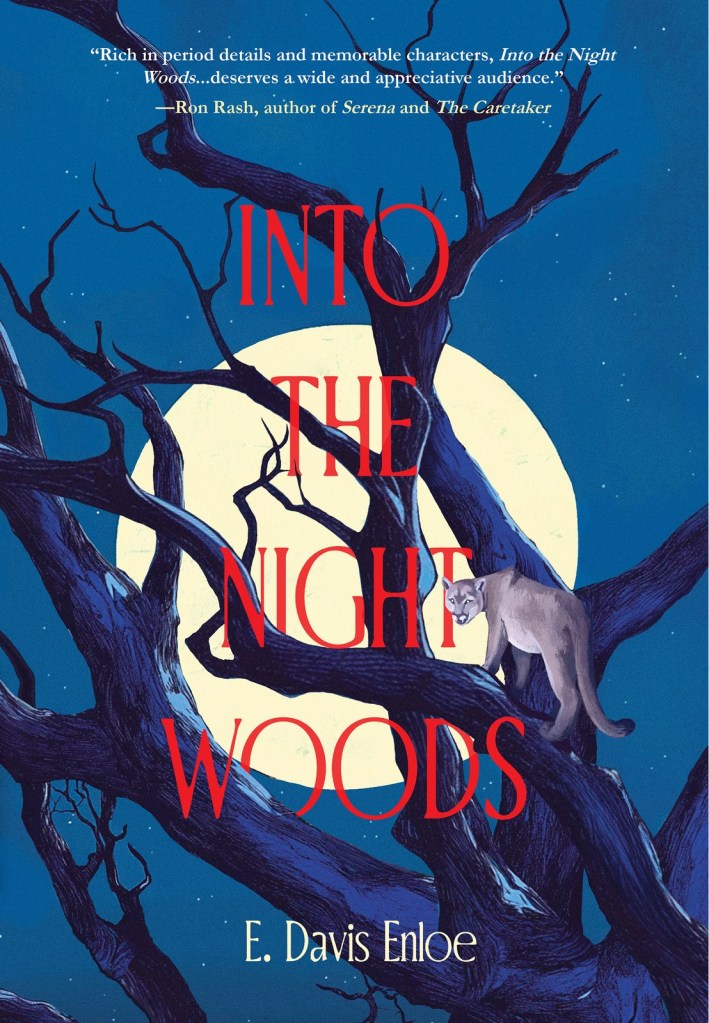
Into the Night Woods
By E. Davis Enloe
Regal House Publishing
Published April 14, 2026


