
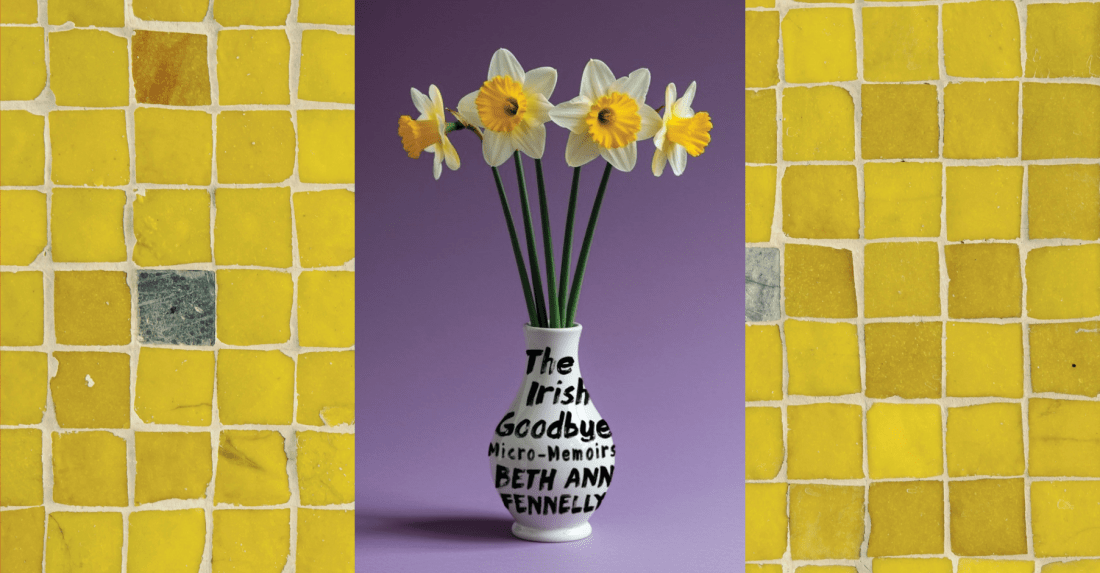
Former poet laureate of Mississippi, Beth Ann Fennelly, maven of the micro-memoir, has done it again with The Irish Goodbye: Micro-Memoirs. I was introduced to this form — also called flash memoir, mini-memoir, or flash nonfiction — during my MFA program, when I was required to read Fennelly’s 2018 volume, Heating & Cooling: 52 Micro-Memoirs, for a creative nonfiction seminar.
Even now, it’s hard not to think “Beth Ann Fennelly” when reading, or reading about, “micro-memoir,” because she is so intimately associated with the form, even being credited with founding — certainly with popularizing — it.
As a screenwriter, I’m drawn to Fennelly’s work because I admire how she quickly dips in and out of a scene; she knows where to start and when to finish, leaving behind some startling or sublime emotional kernel, some essential matter.
I think of Fennelly’s micro-memoirs as “essays,” but only because of the most simplistic definition of essay as a short piece of writing on a particular subject. Another reader may think of them as “poems.” We would both be correct, I think. Fennelly’s work doesn’t so much defy genre as weave it. Each essay or poem derives its power from the braiding together of both story and lyricism.
In The Irish Goodbye, there are 45 micros that range from one sentence to several pages. As she did in Heating & Cooling, Fennelly writes about marriage in micros whose titles start with “Married Love,” but in this new volume her husband primarily plays a supporting role. Her thematic focus is on her sister and her sister’s death, on her mother and her mother’s Alzheimer’s, and in general on remembering; the dedication reads “In memory of my sister and in memory of my mother’s memory.”
Take, for instance, the micro “Only the Basement,” in which she writes about her sister’s memory, potentially faulty, of being locked in a dark basement as a child:
“Now my sister, who either was or was not locked in a dark basement, is dead. And my father, who either did or did not lock my sister in a dark basement, is dead. And my mother, who either did or did not lock my sister in a dark basement, has lost her memory. My mother, regarding remembrance, is as good as dead.
Now it’s the truth that’s locked in the basement. Only the basement knows it. Only the basement, and its confidant, the dark.”
The author continues to grapple with her sister’s death in “Fennessy,” one of the most affecting micros at the center of the collection. The narrator reads a new novel published by a friend, who has used Fennelly’s sister’s name, with only a small typographical change, for a character. The narrator is emotionally wrestling with that fact, just as she’s emotionally wrestling with her own grief:
“Every time it strikes my eyes, I read my sister’s name, autocorrecting…
In this way, reading the novel is like reading my life. The main character keeps tripping over the minor character, who exited early.
Who gets to decide who is main and who is minor? Who gets to decide who exits early? Some joker who seemed like a good guy. Some joker gets to decide who ends up framed, who turns the page.”
Amid these forays steeped in memories of her sister, there are several others about everyday life, family, travel, and work that contain either a poignant detail, image (I can’t help but think of Cathy Smith Bowers’ “abiding image” here), humor, or observation.
In “My Mother-in-Law in the Mirror” she captures the selflessness of her mother-in-law in a single detail: “Once, when the hall bathroom was occupied, I went into the one attached to her bedroom. On her mirror was a Post-It. ‘It’s not about YOU,’ she admonished herself.”
In “While You Were Out,” one of my favorites, she describes the “undercrease” of her son, “where chin meets neck”: “It smells like his stuffed monkey and glue sticks and earthworms and maple syrup, it smells like God.”
In “Married Love: Rolf und Helga,” one of the funniest, robotic mowers are as “sentient as the planchette of a Ouija board.”
In “Tree Pose,” as students flail and fall, a yogi says, “Stop comparing yourself to others. If you compare, you are not a tree, you cannot be a tree.” The narrator’s response as she stands rooted, tall? “Bitch, I’m a tree. I’m just a species of competitive tree.”
These delightful nuggets, worthy of reading and re-reading, are supported by Fennelly’s pithy and wise observations about life, as in “Most Days are Days Like This”: “If you have gin, there’s no tonic, if you have tonic, there’s no gin, and if you by chance have both, for sure you lack a lime.”
So, say hello to The Irish Goodbye, but don’t duck out too early. Abide and stay awhile.
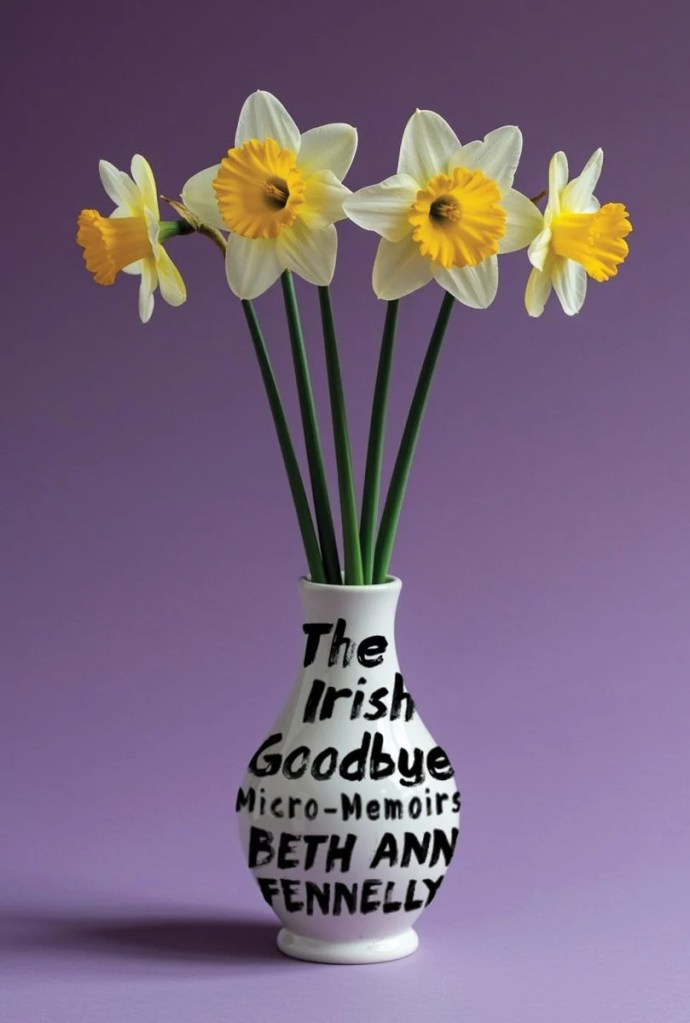
NONFICTION
The Irish Goodbye: Micro-Memoirs
By Beth Ann Fennelly
W. W. Norton & Company
Published February 24, 2026


