
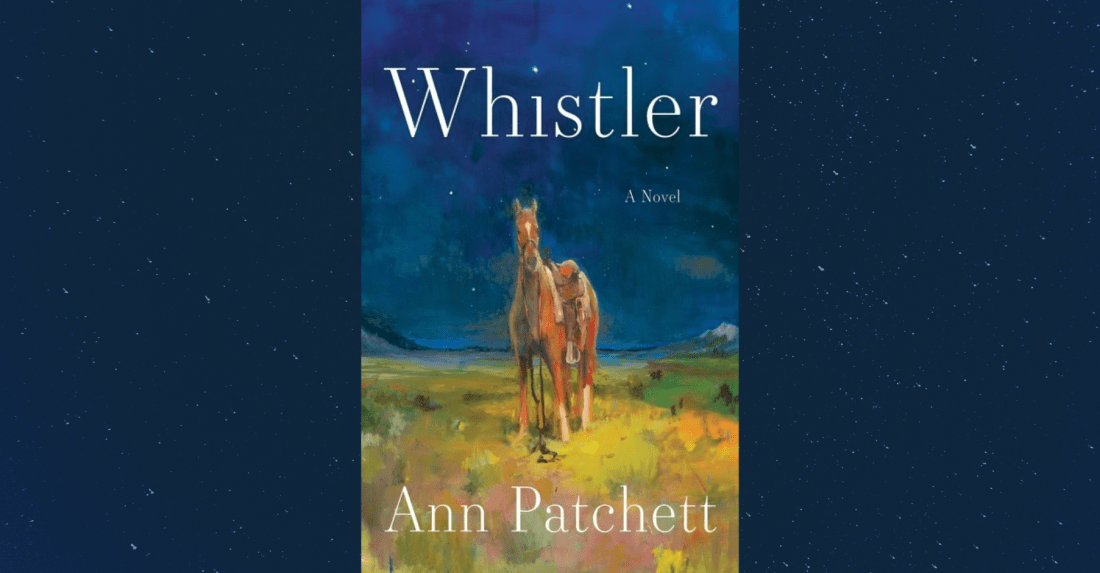
Ann Patchett’s novels examine the bonds and secrets of families — those connected by blood, forged through marriage, and built between strangers as they weather difficult circumstances. Her latest, Whistler, is no different. It is told with Patchett’s trademark subtlety and tenderness.
Whistler tells the story of Daphne Fuller and Eddie Triplett, a daughter and her stepfather, whose love transcends both time and trauma. They reunite by chance at The Metropolitan Museum of Art almost forty-five years after a harrowing accident on a snowy road that precipitated Eddie’s divorce from Daphne’s mother Abigail when Daphne was nine — a divorce that Daphne blames herself for.
The reader learns about Daphne and Eddie through both a series of conversations that reference the accident obliquely and other sections that put us back in time in the car with Daphne and Eddie as the accident occurs. This combination builds our understanding of the characters and their actions with perfect pacing that made me invested in them and interested in what they had survived.
Even the most dramatic scenes are experienced through Eddie’s calm demeanor and reflect Daphne’s complete trust in and affection for him.
In the earlier timeline the accident occurs when Daphne’s sister Leda is in the hospital for appendicitis. Eddie and Daphne decide to drive to a raspberry patch to look at the stars, which would shine brightly on a cold night in the countryside. When Eddie misses the road, the car falls down a hillside and ends up on its side. Stranded in the cold, with little chance of rescue, he tells Daphne the story of a woman who gets thrown off a horse named Whistler and the ghosts that visit her before her eventual rescue. It’s not a spoiler to say that Daphne and Eddie are rescued, too, cueing up the later reunion and the story that follows.
The museum setting in the later timeline is no surprise. Art plays a role in most of Patchett’s novels: there is a play in Tom Lake, an opera in Bel Canto, and art and literature in Whistler. Her characters find refuge and employment in the arts, and the richness of this is reflected in their experiences.
In the museum Daphne admires a piece of granite carved with the image of two horses: “Or maybe it wasn’t two horses so much as it was one horse and its ghost,” she muses. With this sentence the author introduces two motifs that will run through the book — horses and ghosts. Whistler is a novel that celebrates the impermanence of our existence and the love that makes it all tolerable.
When Daphne spots Eddie walking behind her and her husband Jonathan, she thinks to herself that Eddie wants to die. “How did I know this? Because I wanted to die myself, and our hearts were forever stitched together, mine and Eddie’s.”
Eddie’s appearance awakens Daphne’s long-suppressed memories of the accident, the time before it, and their affinity for each other.
They spend the afternoon together and, when they hug goodbye, Daphne smells Ivory soap and is “overcome with the memory of that smell, the single night I had slept with my face buried in his neck for warmth.”
The novel goes on to explain their deep connection as it interweaves the story of the accident that separated them with the reunion of the two as they fill in the blanks of their personal histories and build new memories.
One night, for example, as the two crash a wedding, the reason for Abigail’s and Eddie’s divorce is revealed. As they leave the party, Daphne brings up the story of Whistler, the horse:
A few small clouds sailed miles above us, passing the moon. “Do you remember the story you told me that night in the car?”
“Which one?”
“The one about the woman and her horse.”
“Oh, that one,” he said. “Of course I do.”
“Whistler,” I said, and suddenly I was afraid I’d cry again. Being drunk was a terrible burden.
“Whistler,” he said, looking up at the moon between the buildings. “That’s right.”
“I thought about that woman and her horse for a long time after you left, and I wondered if maybe you’d told me the story because you were leaving and you wanted me to know you’d come back for me, which, of course, you did.”
“Only it took me considerably longer than you thought it might.”
Of course the reader knows Daphne and Eddie must part again some day, but the book keeps us firmly rooted in their present, even as Daphne accompanies Eddie to chemotherapy sessions to treat his leukemia.
Whistler is a gorgeous novel about a special love and the power of stories to provide hope, help us cope, and keep us connected to what we’ve lost.
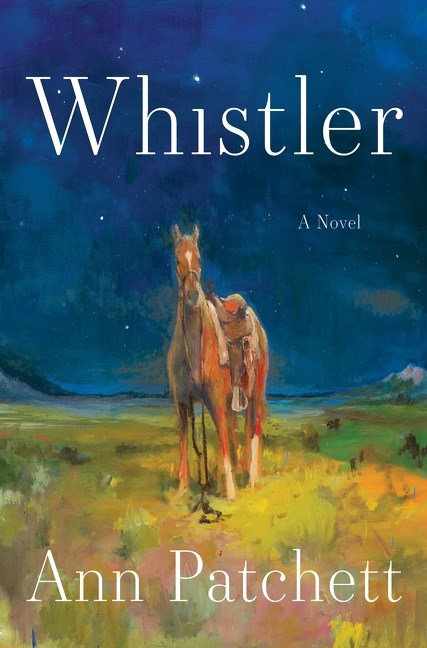
FICTION
Whistler
By Ann Patchett
Harper
Published June 2, 2026


