
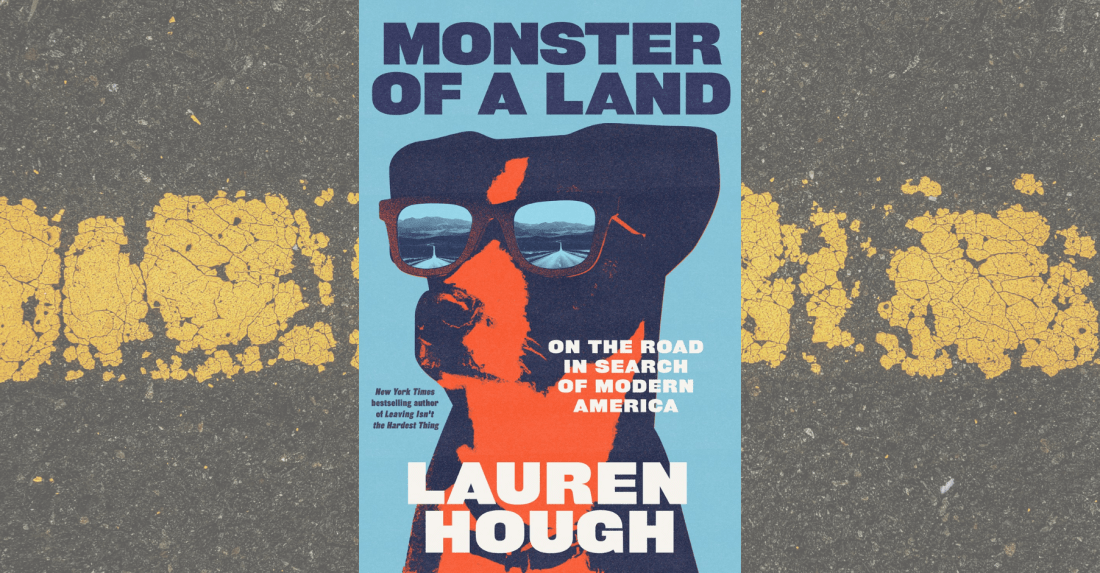
Lauren Hough shot to internet fame when her 2018 essay “I Was A Cable Guy. I Saw The Worst Of America” was published in Huff Post. The title says it all, so as Hough chronicles her Steinbeck-inspired trip across America in Monster of a Land, a reader can’t be faulted for expecting more of the same revelations. Prepared to be surprised. At almost every turn, all 6 feet of Hough’s butch lesbian energy and curiosity incites goodness, warmth, and honesty from the people she meets across the US. It doesn’t hurt that she’s travelling in a Rocinante-inspired Dodge van with her pup Woody, a “Good Lookin’ dog.”
In the current political situation, it would be easy to assume that Hough would be horrified by the people she meets on her journey. The reality is the opposite. From Dorothy, who Hough meets in line for beignets at Café du Monde in New Orleans to Wayne, a proselytizing hitchhiker, she is consistently met with warmth and kindness. Likewise, buoyed by the energy of community, Hough extends kindness to others she meets on her trip: Cash, a young “vagabond” who shares her campsite; a young mother and child who Hough drives to safety in Bakersfield, CA; and a nameless woman in Winslow, Arizona, for whom Hough pays for her cat’s euthanasia. Having deleted her TikTok early in the trip, Hough finds that it’s far easier to find the goodness in humanity live and in person rather than from behind a screen. “I can’t help but wonder who and where we’d be if we all just logged off,” she muses.
Hough’s journey is not without emotional weight. She opens with a lovely vignette in the second person in which she remembers a friend with whom she intended to visit the Pacific ocean in California. Their paths diverged, and the next time Hough reached out to her friend, she learned she had died. In addition to the loss of this important friend, Hough references her complicated life to date. As chronicled in her essay collection Leaving Isn’t The Hardest Thing (Vintage, 2021), Hough was raised in The Children of God cult, entered the military as an Airman during the don’t ask, don’t tell era, and after a spate of living in her car, she worked blue collar jobs for most of her post-military life. Hough resists retelling her stories again – instead she reminds us that she’s already told those tales. The emphasis in this memoir is the road trip. However, as anyone who has ever spent time zoning out on the interstate knows, you can’t escape your past, and the story of Hough’s cross country trip is as much a meditation on past experiences as it is an opportunity to live freely and live well.
Among her many charming characteristics is Hough’s reverence for dogs. Throughout the journey we learn about the painful losses of her past dogs, Harper and Teddy. Hough’s grief over losing Teddy has driven her adoption of Woody for whom she devotes herself. Woody’s need to run free incentivizes Hough’s frequent stops in quiet and open places. Hough’s insights about her dogs, including her regrets and perceived failures over “the dogs who got me when I couldn’t afford a bone to chew on” add to her emotional depth and creates trust between narrator and reader.
This book is far beyond a modern Travels with Charley. While she captures some of the tone and stance of the objective observer as well as the loose frame of Steinbeck’s book, this work and the journey itself far exceeds the inspiration. Hough is not only forthright about her occasional nights in a hotel when the van gets too hot (Steinbeck fans will know that he was not), but she completes the cross-country trip that Steinbeck couldn’t. Further, Hough brings in layers of other road trip books, including Krakauer’s Into The Wild, Kunstler’s Geography of Nowhere, and Raban’s Bad Land (she lists quite a few more following the acknowledgements). Blessedly, Woody survives the trip where Charley didn’t, although the Dodge van died in 2024.
I imagine Hough would recoil from the label of “sage,” but she has much to offer in this book. Her details about outfitting the van for the road trip, including her custom travel toilet box, are compelling and invite a reader to ask herself — can I do this too? Her humorous speculation about how she would bring ‘shrooms on the trip (she most certainly did not) is clever and a stylistically interesting section of the book. She clarifies one of the many values of writing in her rebuke to her brother’s suggestion to use AI. Of writing, she notes, “This is where I go when it’s too much and I don’t understand enough to even know the right question,” echoing the thoughts of many writers. At the heart of this memoir is the feeling that Hough is not just a truth teller, but reading about her life can help you understand your own, even if you’re not a 6-foot-tall lesbian in a broke down van with “Bass Blaster” and “I Break for Moose” bumper stickers.
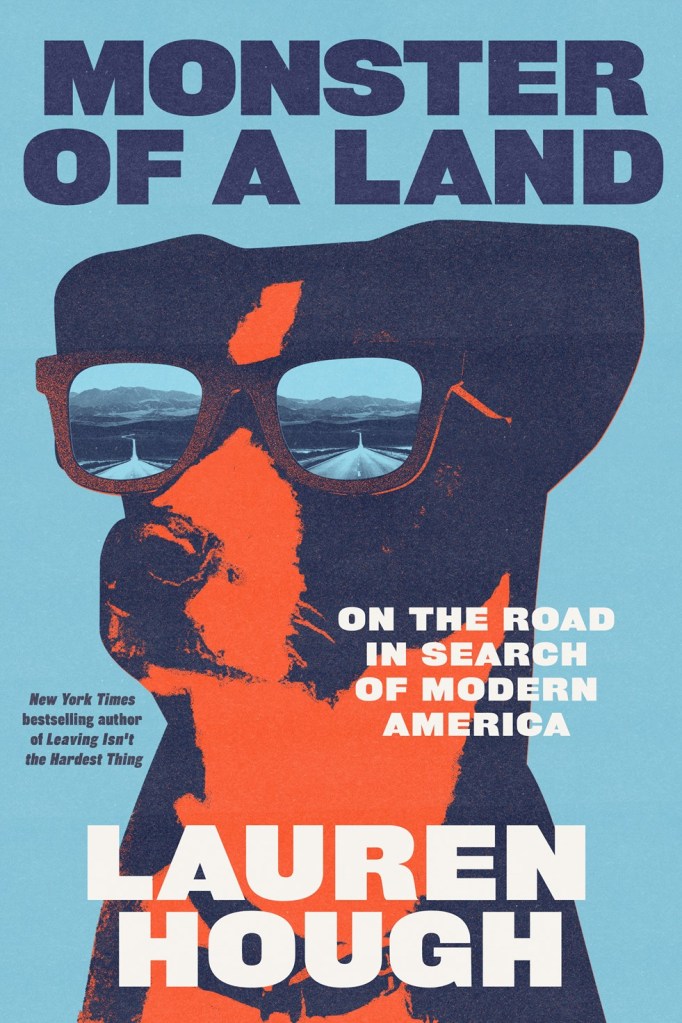
NONFICTION
Monster of a Land
Lauren Hough
Pantheon Books
Published June 16, 2026


