
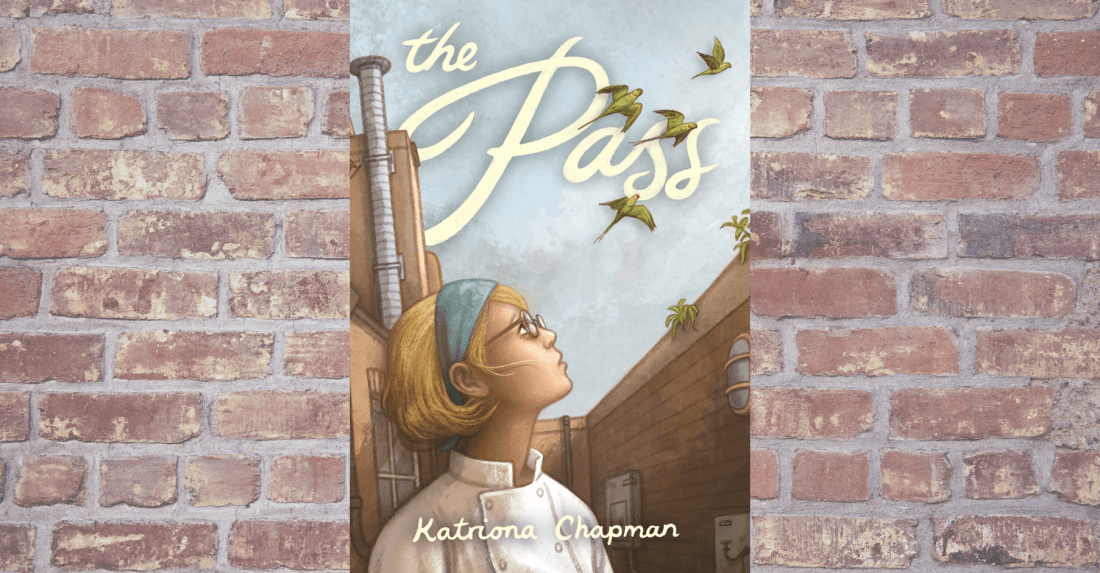
Katriona Chapman’s latest, tender-hearted, character driven graphic novel The Pass has all the ingredients for a great comic: a gorgeous, painterly art style that depicts the intimacy of everyday moments with an eye for realism, an overworked chef whose crush on her best friend/sous chef sizzles between them until it threatens to get in the way of her entry in the Chef of the Year Competition, the pressure to perform and meet her parents expectations as well as the inheritance of her father’s fame and success looming over her own booming restaurant, The Alley.
The hardback comic, designed by Kayla E, sets the tone that this is a serious work of storytelling, with an image of the kitchen on the inside front cover, where we catch a glimpse of how Claudia’s work steals most of her time away from other important parts of her life, like friends or family. This is an author who has developed a career in comics. Her previous book, Follow Me In, won The Broken Frontier Awards Best Graphic Nonfiction Prize, and her other graphic novel, Breakwater, made the New York Times Top Ten Graphic Novels. If that weren’t impressive enough, her initially self-published comic Katzine also received the Broken Frontier award for Best Ongoing Series back in 2017. She understands the strengths of the visual medium and how to best operate within the constraints of the form, taking advantage of a comic’s ability to expand and compress time in a way prose alone could never do.
Though Chapman takes us through her slice-of-life narrative, moment by moment, in panels, the way she enlists them on the page reveals her visual storytelling skills. She’ll give us a frame of the Alley in the literal alley where our protagonists spend much of the book, then zoom in to a restaurant conversation between Claudia, in her full chef garb, and a journalist. Next, we’ll see a single page of her opening a pot, followed by close-up panels of her cooking, putting us in the moment and highlighting her passion for the work she does at Alley. Her characters are visually rendered in a serious tone, with brushstrokes reminiscent of Chagall or Monet, but in comic form. Without captions, this is pure visual storytelling, allowing us to eavesdrop on conversations between characters that feel very human and painstakingly real, such as those between Claudia and her family, or especially the moments with her team after the restaurant has closed. The atmosphere is tense from the get-go, though as the competition begins, the stakes rise, and the scenes seem to fly like one of the birds outside Claudia’s windows across the page.
Chapman also excels at providing us with multiple perspectives, so that we can understand how, without each member of the kitchen, the restaurant can’t function, and no meal gets made alone. Every protagonist feels equal in the way Chapman tackles their exterior life, and though we don’t get any captions revealing their interior thoughts, the expressions on the characters’ faces and the moments of pause let us see the exhaustion and frequent anxiety that come with the service industry. I appreciated how Chapman shows the reality of being a working parent and the many plates juggled by those who work behind the scenes in the restaurant. Even the protagonists’ parents are active players in their lives, rather than being reduced to background characters. They feel fully developed and reveal the impact of parents’ approval and validation on children long after they grow up, especially when it comes to prioritizing financial decisions over passion. Everyone at The Alley has a lot on their plate, which makes the romance stirring up between Claudia and Benjamin even more compelling, a slow burn that simmers in the pot.
The subdued green and brown color palette that permeates throughout the book gets darker in moments of tension and lighter in scenes of emotional catharsis/relief. Chapman’s loose, whimsical speech bubbles create a dynamic feel to the dialogue, helping to set the pace of the narrative by creating either a natural back and forth as fast as the clang of dishes during a weekend, or a moment as slow as an hour when none of the tables are filled, and there are more chefs than meals to cook. The lettering guides our eye toward a second layer of conversation between the characters through their body language: baggy eyes, hunched shoulders, smile lines, furrowed brows, expressions of concern for one another, and their shared community. The handwritten element of the font creates a sense of interiority, drawing us into the unspoken thoughts of Claudia and Benjamin and putting their close emotional bond on display.
Just as Joan Didion’s The White Album captures the heart of Los Angeles in the 60’s, making the place a vital character in the narrative, so too does Katriona Chapman capture the food industry from the perspective of a chef desperate to prove herself and succeed outsideof her father’s shadow by offering visual glimpses into the stress of familial expectations and the ways her relationships, both romantic and platonic, suffer. It is in the immediacy of everyday moments that we witness her grow and evolve in her career and identity. We get to know her best in simple panels that depict ordinary yet vulnerable dialogues exchanged over meals and family dinners.
“Life changes fast,” wrote Didion, “You sit down to dinner, and life as you know it ends.” For Claudia, Benjamin, and the found family of a crew at The Alley in Katriona Chapman’s The Pass, life changes fast all the time. Life may end when they sit down to dinner, discussing the hardships in their relationships and their worries about their competition, and some threads may never be fully tied when it does, but in the case of this tight-knit crew and their complex, loving families, life and love always begin again in the kitchen.

FICTION
The Pass
By Katriona Chapman
Fantagraphics Books
Published January 20, 2026


