
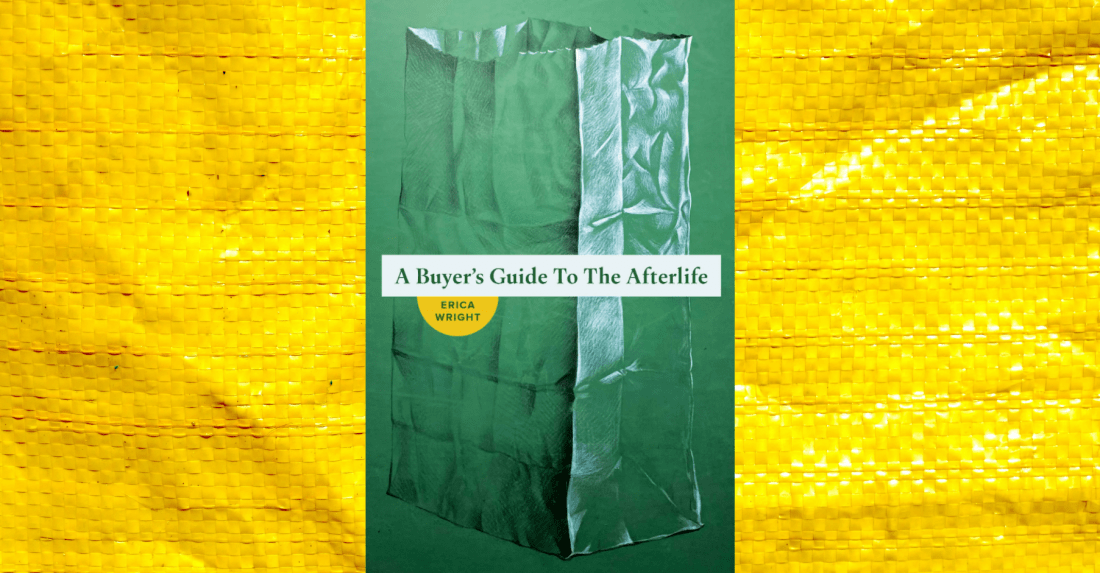
In an interview included in the soon-to-be-released documentary on great American poet Mary Oliver, Saved by the Beauty of the World, Oliver shares that she is “most worried about […] a most serious, ongoing devastation of the Earth, which we need both spiritually and materially, and we’re not dealing with it. I worry about little children. Are they going to know what the earth looked like?” Nature is changing; we want to preserve the world of our childhoods and cannot. This fear of loss underpins climate anxiety and hard-boiled conservatism alike. In A Buyer’s Guide to the Afterlife, Erica Wright uses the power of poetry to preserve what she can in an earnest archive.
Wright’s collection records an eclectic variety of losses for posterity. Each poem focuses on a creature, a dream, a climate, an opportunity, a faith, or a sense of time. A handful of micro-poems (titled “Microscope”) neatly encapsulate memories, such as the following poem as it appears in its entirety:
Microscope: Joy
The teeth of a fine snail.
More often, however, complex experiences are compressed into solid monostichs, couplets, and tercets. Memories are sealed up in an allegorical, anecdotal style reminiscent of Ada Limón’s The Hurting Kind, or within speculative conceits that trap experiences of loss which are harder to contain. For example, Wright architects a city of lost things in the collection’s second poem, “The Unknown City”:
We invent a city for loss, keep childhoods there,
love letters and pennies, the last time we slipped
our feet into the leech-filled waters of a creek,
marveled at hunger, then at weightlessness.
This “weightless” poem invites us as readers to shed the gravity of recollection and forgive ourselves for forgetting even what we have forgotten. In “Still Life with Time Travel and Pears,” the speaker imagines a future loss: namely, how the age difference between herself and her child will create emotional distance between them as she ages. Wright documents the speaker’s many hopes, including a hope that the baby will “think / it was worth it, me / waiting so long // to welcome a child.” The poem encapsulates the speaker’s fear that dying earlier as an older parent will cause grief and loss: “Your age plus mine / equals what new cost?”
Future losses in A Buyer’s Guide to the Afterlife are predominately ecological. Erica Wright’s speakers watchfully document and interpret auguries in nature as another way of managing their anxiety. In “The Only Bad Luck Bird,” the speaker asks:
Is it the swan,
big as a stove,
sad as a god?
Or the crow
that names
each morning?
In “Unlikely Mammal,” the speaker wants “those bats to prove they’re bats, / not starlings mistook for succor.” References to crows and bats remind us that Erica Wright has made a name for herself as a gothic genre writer. A review in now-defunct NEON claimed that Wright’s first poetry collection, Instructions for Killing The Jackal, was “not afraid to use the darkest of imagery combined with a violence of language, including gothic images like rust, teeth, nails, the Devil, etc. By contrast, A Buyer’s Guide to the Afterlife inhabits a world of storms and hurricanes which threaten houses and fauna.
The primary horror in Buyer’s Guide is that of humans making homes and families which they struggle to protect. In “A Common Illusion,” a parent reflects:
I’m in charge in case of emergency.
What could stop a bullet besides my body?
That’s not a rhetorical question.
Yet even wrangling against existential horrors, Wright reminds readers that even this imperfect moment in which we exist is worth noting carefully and archiving. In “Oil and Water,” the speaker describes a beautiful but ominous sky as she’s traveling for a funeral:
I sweat through my best dress,
say my goodness to the cashier
who tells me it wasn’t always so hot,
not as pretty either, he assures me.
I wonder if he means the refineries,
and God bless, he’s right about their glow […]
Imperfect moments are also documented in Wright’s Inventory poems (“Inventory at Thirty-Eight,” “Inventory at Thirty-Nine,” etc.). These time-capsules offer moments of presence amid recollections of the past.
Repetition and recollection can cause even the most precious memories and messages to melt into background noise. Wright’s last inventory poem reminds a child to be “gentle, gentle”:
Gentle, we say again and again, hoping
the suggestion sinks in rather than loses
its meaning like when you say thermometer
so many times you decide that can’t be right.
Thermometer? Thermometer.
Though her poems are compulsively-contained against a backdrop of anxiety, Wright’s work exhorts readers not to ruminate. A Buyer’s Guide to the Afterlife encourages readers to dedicate fresh attention to the natural world, and not to let our fear of change paralyze us. It is “together” that we can make a better world for those who come after, as Wright says in her final poem, “The Migration”:
I want my son to know
a world where nothing
is louder than the wind
he mimics each morning,
raising his head to find
the manmade wonders
among the God-made ones.
Together, it’s a lot of wonders.

POETRY
A Buyer’s Guide to the Afterlife
By Erica Wright
Black Lawrence Press
Published July 21, 2026

 Southern Review of Books