
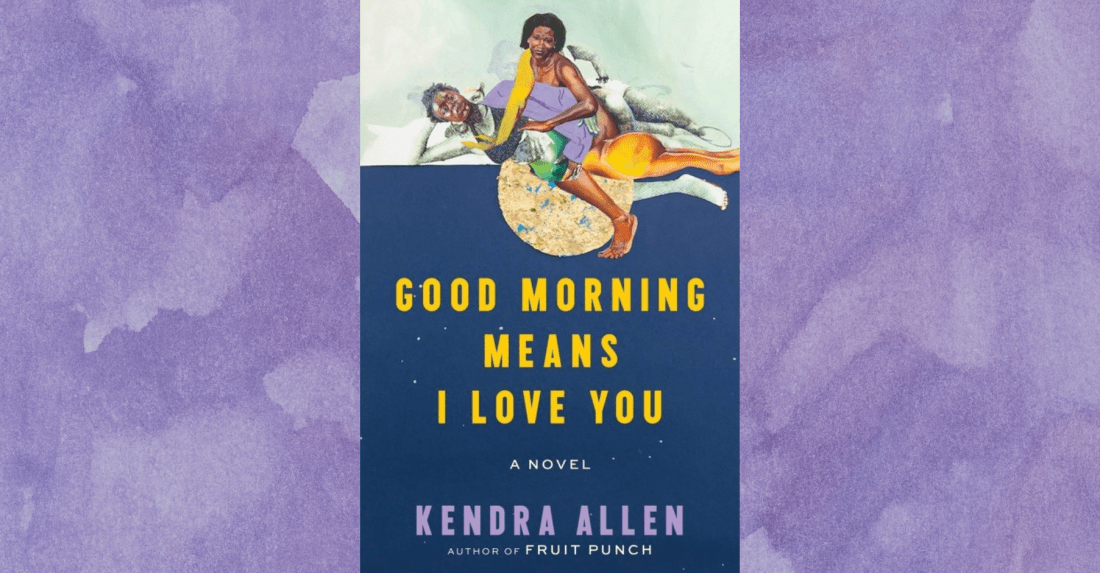
Kendra Allen’s first novel, Good Morning Means I Love You, follows the trials of a free-spirited young Texas woman named Raenell (“Rae”) and her unorthodox family, which comprises her two male partners, Noon and Micah; the children they share, Morning and Night; and the extended family that includes her mother Kathy and half-sister Dory, as well as other half-siblings and in-laws who emerge over time.
Having previously published both a memoir, Fruit Punch, and a poetry collection, The Collection Plate, it is clear that the prose owes its style to a unique alloy of those mediums, as lyricism, personal history, and confession often collide and intertwine within.
The novel begins with Rae’s return to the family after a self-imposed exile shrouded in mystery — but, as we learn, an exile not entirely unexpected or misunderstood. Through the course of the story, we learn that Rae experienced a life-threatening hemorrhage after giving birth to her son Night. During the throes of Rae’s postpartum depression and related absence, Noon files a malpractice lawsuit that is the root of considerable tension among the three partners. Eventually, Rae has another bout of bleeding related to the postpartum hysterectomy, and the severity of the stakes come into climactic, stark relief.
The author deftly employs the fraught trivialities of life almost like the childhood game of “Operator,” in which even the smallest of gestures can trigger an unexpected jolt, revealing currents of anguish that flow just beneath the surface:
Inside, I chugged water and soaked potatoes and boiled eggs in white vinegar. We ate straight from the pot, and Night guzzled down his share, but Morning refused. He was intermittent fasting or sum, iono, but I decided in that instant I needed him to like me if I was gonna live here. I needed him to wake up – not to say I remember you, but to hold on to my finger, and show me where to go.
The collective traumas that course through the lives of all the characters — separation, grief, loss, loneliness, and, most saliently, guilt — manifest themselves throughout the book at similarly unexpected times, just as they do in life. The contrast is presented quite dexterously, as the otherwise humdrum household activities that are often described in the book are consistently revelatory and infused with meaning and possibility: the possibility of love and growth within whatever family we choose to make. The methodology behind Allen’s prose is clever and steadfast: with all that we have to work through just to get through one day, the one thing we do not have time for is guilt.
Tellingly, much of the work exists in the tender yet fleeting, almost semi-conscious moments between mother and child, lover and lover(s), mother and daughter, siblings, in-laws, etc. Though the moments within can border on the mundane — children and adults eating, doing dishes, playing, touching, fighting — the dialogue is dizzyingly realistic, and the lurid quality of Rae’s first-person narration mines the very nature of womanhood, motherhood, daughterhood, personhood, and, touchingly, body-hood. Informed by the postpartum trauma of the protagonist, the author is asking big questions through Rae: What does it feel like to be human? What does it mean to be alive? How much of the universe is contained inside this moment?
Finally, it is worth revisiting the prose through the prism of Allen’s experience with the modes of memoir and poetry, as the narration is so audacious it sometimes borders on the nonsensical, for example, “…And nothing’s about heat. And heat’s about mourning. And mournings are about sons. And sons are about limits…,” but it is never inauthentic. Allen seems to suggest we don’t need the answers — all we have is the moment anyway.
Though the extremely inventive first-person narration of Good Morning Means I Love You conveys intimacy in astounding and often alarming ways, unflinching as it is in its portrayals of natural human experiences such as sex, eating, childbirth, and even bodily injury, it is through this intimacy that the novel extracts where love, trauma, awakening, and forgiveness really lie: in your body, and where this book reaches you — under your skin.
FICTION
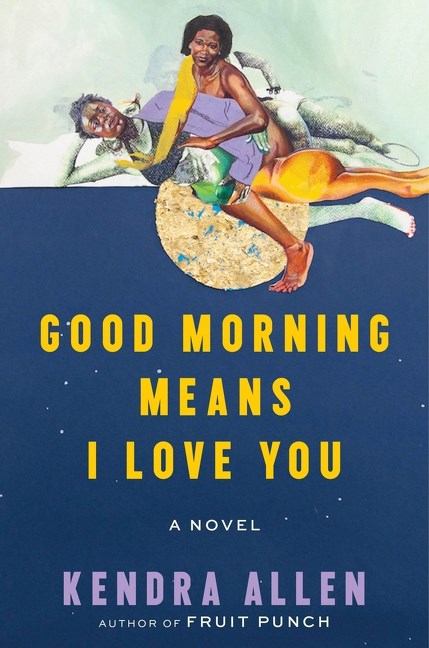
Good Morning Means I Love You
By Kendra Allen
Ecco Press
Published July 7, 2026

 Southern Review of Books