
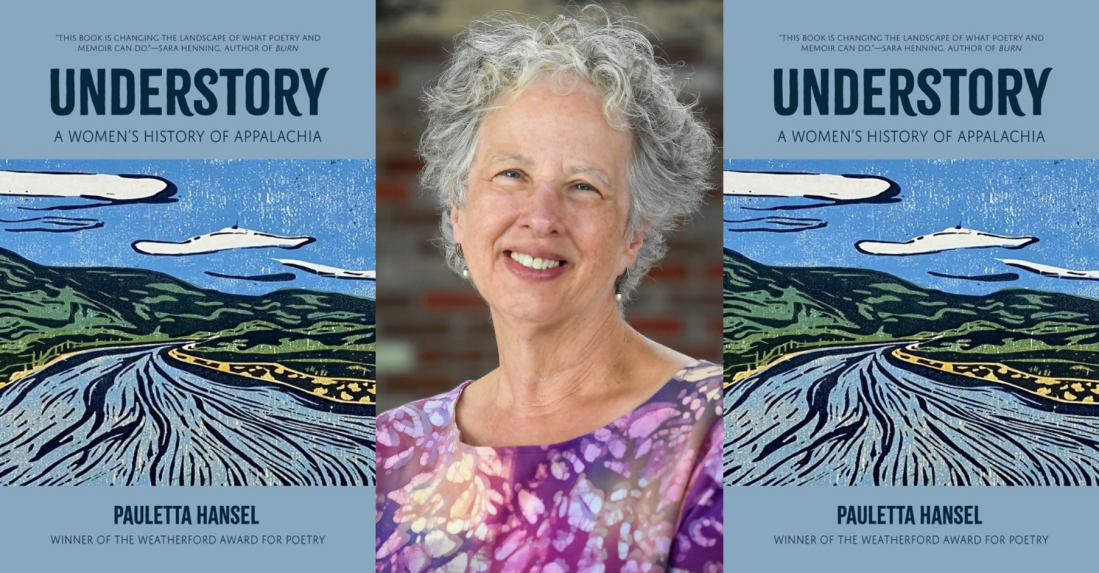
In her new book, Understory: A Women’s History of Appalachia, Pauletta Hansel combines history, genealogy, memoir and poetry to foreground the lives of fourteen generations of her maternal line, beginning with her tenth great-grandmother, Margaret Dawson, a “Tobacco Bride” who arrived in Jamestown, VA in 1621, then following the family westward in geography and forward in time, through the Revolutionary War, the Civil War, the Industrial Revolution, and ending with her own mother in Kentucky. Hansel writes, “If my granny, with all she endured, still created the circumstances for her daughters to thrive, what did Sarah Margaret — married at fifteen and swept away from her people — do to encourage Etta’s perseverance? And before her, Evaline, Bettie, Eveline, Polly, Rhoda, Anna, Betsey, Mary, Elizabeth, Rachel, Hannah, Joanna, Margaret? If I don’t tell their story, no one will. Maybe it doesn’t matter, but it strikes me that the story of my maternal line is a story of Appalachia — gnarly, knotty, and ridden with decay, buffeted by floods, with roots scraped away to power the rest of the country, but our story nonetheless.”
Pauletta Hansel is a poet, memoirist, and teacher whose eleven books include Understory: A Women’s History of Appalachia (University Press of Kentucky, 2026), a hybrid of poetry and prose. Individual pieces have been featured in The Pittsburgh Review of Books, Cincinnati Review, Oxford American, and Poetry Daily, among others. Awards for her writing include the Poetry Society of Virginia’s North American Book Award, the Weatherford Award for Appalachian Poetry, and the Judy Gaines Young Book Award. Born and raised in southeastern Kentucky, Pauletta received her MFA from Queens University of Charlotte and was Cincinnati’s first poet laureate and Writer in Residence at Thomas More University, WordPlay Cincy, and the Cincinnati and Hamilton County Public Library.
You write, “In Understory, I write to lift this shadow of invisibility and silence.” How did you decide to focus specifically on women’s lives, especially as centuries rolled forward in the story of America?
I would say that decision was a combination of original intent and also a survival mechanism as a writer, given the sheer volume of ancestors in this line. Certainly, Margaret Dawson, the tenth great-grandmother who was a Jamestown bride, is who brought me into this work. She was brought over from England to be married off to a settler in exchange for tobacco leaves. She was a point of history already in the history books as one of the Tobacco Brides, the Jamestown Brides. There’s a PBS mini-series called Jamestown that tells these women’s stories.
Coming from a family, as I end one of my poems, “as common as our people were,” to find a specific name and a specific person who shows up in historical documents was interesting and something worth following up on. That was one, but then the other inclination was that I’ve always written about women. The question became: who was the next woman, and who was the next woman?
It highlights a way that women learn from women. Even if you only have small scraps to work from, women coach their daughters in survival techniques, survival skills — intuitively, that comes through. If not for the women, each generation of women would probably not have survived to make it this far.
Absolutely. As I was creating poems, I was making this segue into historical fiction, right? Because there was so little information to go on with these women that I had to take what I knew and add what I was curious about. That is the part where, to paraphrase Frank X Walker’s rules of historical poetry, this combination of research, imagination, and compassion came together. Wanting things for these women that they may not have had — I have no way of knowing that, but I could at least create it on the page.
Understory reveals the way generations of your earliest American ancestors trekked across the eastern states from the Jamestown Settlement in eastern Virginia, and across the southwestern corner of Virginia, through Maryland, North Carolina, eventually to Kentucky. Why did you feel it was important to set foot on the ground your ancestors, the Rhotons, had walked upon?
It felt important as a poet and as a memoirist, because by the time I started doing a little bit more of the directed travel, I already knew that I was writing prose as well as poetry, and that in order to write prose that was more than just a regurgitation of historical material I needed to have another through line. And that through line was my own journey of discovery. And the journey was a metaphorical journey in the sense of what I found out and how it affected me, but it was also a physical journey. All of that became part of the narrative.
You can’t just make it up; you might know that a certain kind of tree grows in a forest, but until you actually see the tree and smell it and feel it, it’s a little bit more difficult to write about. In order to write the poems, which come from concrete experience, I felt as if it was important to be there and to write about what happens there. You know, if I’d never gone to the graveyard in Yorktown — I have no idea whether or not my tenth great-grandmother, Margaret, was actually buried there — but if I hadn’t gone there, I never would have used that tulip poplar tree that pelted me with its blossoms as a way of talking about Appalachian people and Appalachian migration. Nothing was useless.
Throughout the book, you have written introductory essays for each section, a narrative that chronicles your search to find historical markers and remnants of where your foremothers once lived. Earlier books of yours, like Will There Also Be Singing, contain historical documents; Palindrome and Heartbreak Tree contain letters and news articles threaded through the poetry. How and when, in the process of compiling this book, did you decide to create a work that is intentionally multi-genre(d)? How do you see the function of the “personal narratives” in Understory? Did you imagine an audience as you wrote this book?
I was interested in the work because I felt that the story of my family was a story of American and Appalachian history. Not the story, right? Because there are lots of different histories, but it was a story that could help illuminate Appalachian history within the larger framework of American history. When I was writing poems, I knew that I wanted to have poems that had some of that historical context in them.
I knew I had the capacity to do that, but as I was working with so much material, I started feeling as if I was weighing the poems down with that documentary material. The decision to weave in prose came pretty early. And opened the possibility of putting more historical content within this narrative of my journey of discovery. Then the poems could maintain the intimacy and could really focus in on details about individual women and places.
Yes, poetry can contain history. But it didn’t have to contain all of the history. I could focus in and still have readers see the larger picture by reading the prose.
Even the poems that are laden with historical information find a fascination either with language or etymology or ancient archaic English terminology or something for a poet to chew on, you know?
I think that personal narrative, memoir, creative nonfiction, and poetry do pair well together. It was a risk to do this kind of hybrid. Most poets, when they do hybrid, are more likely to do sort of lyric essays, in a voice that is as much more akin to poetry than it is to history.
I was thinking the prose is so grounded. That it’s a wonderful counterpoint.
Well, I hope so. And that is, for the most part, the kind of prose I write. When I write creative nonfiction, I don’t tend to move into lyric essay. I can be kind of snarky in prose. And humor is important to me in prose in a way that it’s not necessarily as important to poetry.
This is my voice. Understory, maybe more than any other of my books, shows the full range of my imagination, my intellect, and my voice. Yes, I contradict myself. I am vast. I don’t perhaps contain as many multitudes as Whitman did, but I have a few multitudes in there.
As I was reading Understory, especially in the final section, I recalled your Weatherford Award-winning book, Palindrome, the portrait I saw of your mother. Do you think there are creative connections between Palindrome (or your other books) and Understory?
I would say every book leads you to the next one. But in a way, I think that the bridge book for me was Will There Also Be Singing? because it was a bridge between the more intensely personal Heartbreak Tree and this book, which is personal, but also historical, and I delved a little more deeply into documentary poetry. Heartbreak Tree had some of that, and Coaltown Photograph had some, for that matter. And then, you know, Palindrome included my mother’s words to create poems. Each book led me.
It was a way of teaching myself what I needed to learn in order to write this book, but it was also teaching myself what I needed to learn to write the book after that, the book after that. But that’s what we do as writers, right? We keep growing; we keep finding new ways to work through our obsessions. Maybe we find new obsessions too, but mostly we keep working with the same obsessions and finding new ways of exploring them.
Reading Understory, poetry becomes a way into deeper understanding, a way to suss out your grandmothers’ and great-grandmothers’ lives (the “grannies”) through so many details: old English spellings and terminology; Native American languages; ship manifests; documents of inheritance; snippets of dialogue. You explore a range of poetic forms: list poems, monologues, letters, sonnets, cento, among others. Do you think your sense of the potential for expression that can be evoked through poetry has changed or evolved through this project?
I’m not sure that it asked me to find new ways to approach poetry, but I think it encouraged new ways to approach writing in general. This is a hybrid book; I think it created a new opportunity for saying what I felt like I needed and wanted to say. I moved outside the box of poetry, the box of prose, and hopefully I expanded the possibilities of what both poetry and prose could do. I think I feel more that the innovative nature of it has to do with the combination of the two, to bring them together, to have them be in conversation with each other.
One of my early readers asked, “Do you have any models for how you’re doing this?” And it’s Claudia Rankine, C.D. Wright. The people who are really working with documentary poetry and who are not afraid to combine voices, to combine language, to combine a conversation on one page with a poem on the next page. In terms of the hybrid nature, I think that those two were big influences.
In terms of historical poetry, I would say Frank X Walker. Walker’s work is amazing in that he is able to do all of that historical work within the poem. But Frank’s work has tended to be maybe 50, 60 years that he’s covering within a book of poems, so he narrows his focus in a way that this book did not. But, in terms of the poetry, certainly Frank was a huge teacher.
Were there revelations in the research that caught you by surprise or that made you reckon with your material in ways you hadn’t expected?
Certainly the lack of literacy within the family, and particularly the lack of women’s literacy. Another was discovering that my family were loyalists in the Revolutionary War. Part of that was realizing that the family was disenfranchised, even then. There was a sense that we’re being taxed by people who are putting on this war, and that’s not really helping us any. There are certainly parallels there to the idea that when Appalachian people lack access to power structures, they can end up being attracted to something like the MAGA movement.
The other thing, though, was, and I grapple with this in the book, realizing that my family were enslavers. There was no money to speak of in the history of my family, and so it was eye-opening to see that Margaret passed down an enslaved woman to one of her children and that there were enslaved people in the household of one of the early Scott County grandparents. It led me down the path of trying to understand more about the history of slavery in Appalachia.
I did feel like I had the right to invent stories for my own ancestors, based on research and based on what I knew, but I didn’t feel like I had the right to invent the stories of enslaved people that I had no connection to. Including the names of those who were available in the documentation felt like the only, or for me, the best way, to be able to show this larger fabric of the community without appropriation.
I knew that my ancestors were enslavers, and so I had to say that. But I also felt like it would be irresponsible to put more than what was really my right to tell.
Thanks so much, Pauletta, for this conversation about your new book, Understory.
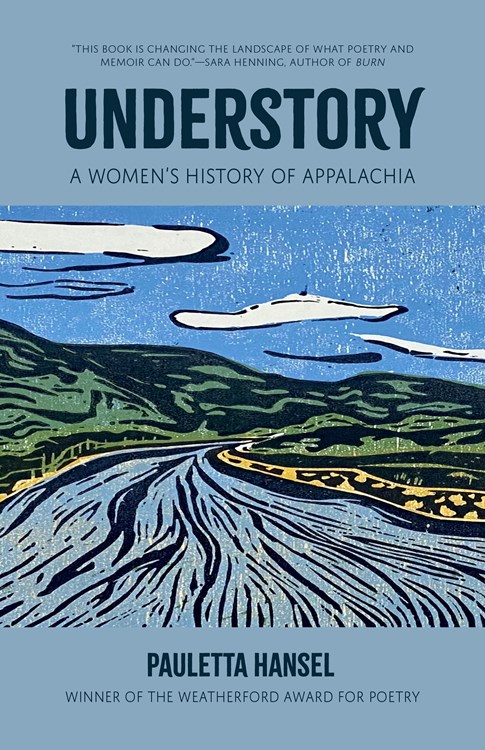
Understory: A Women’s History of Appalachia
By Pauletta Hansel
University Press of Kentucky
Published October 13, 2026


