
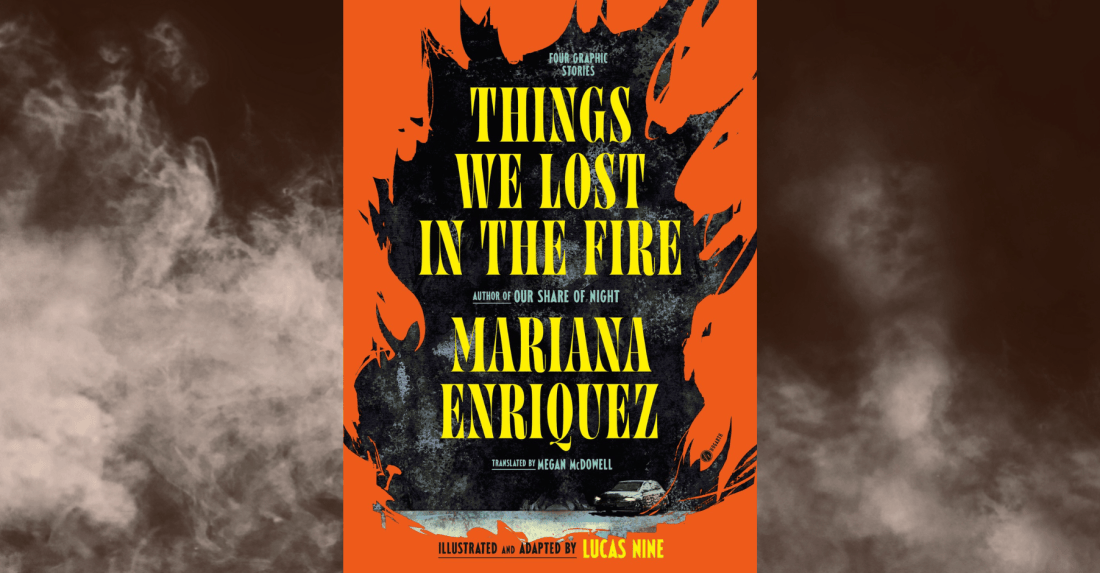
Adapted by Lucas Nine, Things We Lost in the Fire: Four Graphic Stories features a selection of four stories from Mariana Enriquez’s 2023 short fiction collection. This new collection is an amalgam of the work of three artists. Enriquez’s writing ignites the process for Megan McDowell’s translation while Lucas Nine’s visual illustrations and textual adaptation render the stories with graphic illustrations. The result retains a sense of unification, despite the introduction of a different medium to each of the stories.
Before reading the adaptation, I was curious whether they’d be as enjoyably odd as Enriquez’s original short stories. The first few pages contain text for each graphic image. This slowly gives way to more images without text. It’s a smart choice for the first story, allowing the reader to transition into more graphic storytelling. By focusing on only four of the stories from the original collection, it allows for a considered pace that makes the setting palpable. Buenos Aires is present, not just as a city but as a terrorizing action. This is unmistakable through Nine’s choices of color and visual style. Having read some of Enriquez’s previous horror fiction, I expected the use of dark colors to convey dread. It is dark and then, at times, obscure imagery and organic brush strokes add to the sense of occlusion that’s found in Enriquez’s writing. Enriquez builds suspense through her ability to reveal not quite enough, keeping the stories comprehensible, and Nine’s artwork is in sync.
Mariana Enriquez’s stories have often been described as haunting. Her pacing is slow, rhythmic, poetic. Presented as a graphic novel, the pages themselves feel haunted – as if the story has entered the book via imagery and now sits in the readers’ hands. (I placed the book under other books in my office overnight and whispered a prayer that nothing escapes to my dreams. That kind of haunted.)
There’s interplay between reality and obscurity in the graphics, similar to the moods that undergird Enriquez stories. Momentum moves in between what’s real and what’s mythical, leaving the reader not quite sure about where the lines should be – blurred, just like the graphics. This feels methodical and deliberate. The employment of photography gives a sense of reality that transforms into the odd and uncomfortable through brushwork. The story, “An Invocation of the Big-Eared Runt,” moves between past and present timelines as told by a narrator, a tour guide. Black, white and sepia toned photography shows old buildings, people in period dress, and highlights contrasts in past attitudes about mental health, children and crime. Scenes and faces from the story’s present use shadows and thick, deliberate brush strokes in blacks and reds that show the tour guide’s growing enamor with cruelty.
I didn’t expect Lucas Nine’s illustrations would transfer Enriquez’s insights about life in Buenos Aires and retain specificity. But fewer, well chosen words, plus the graphics, create a precise meter through the stories. The reader is forced to linger and contemplate the images. This allows more control over pacing and the effect enhances unease.
Lucas Nine’s sense of the reader’s experience, transposed graphically, creates something new. Yet it keeps to the truth of the original stories. This adaptation retains strangeness and provides an experience that remains adjacent without pulling anything of the source text out of shape.

FICTION
Things We Lost in the Fire: Four Graphic Stories
By Mariana Enriquez
Hogarth
Published October 13, 2026


